Digital Bridges: Overcoming Nepal's Structural and Political Barriers to Economic Mobility
· 53 min read
Undergraduate capstone, Minerva University, April 2026
Web edition of my undergraduate capstone (B.Sc. Applied Computer Science and Artificial Intelligence; B.Sc. Economics and Society). The argument, data and diagrams are unchanged. Interviewees are anonymised, the course-assessment appendices are removed, and the technical appendices are summarised with links to the code.
Summary
Every day, over 2,000 Nepali citizens board planes bound for foreign employment. Nepal’s diaspora now exceeds 4.5 million in a country of 30 million, and the money they send home is worth over 25% of national GDP. Nepal does not lack talent. Its workers build Qatar’s infrastructure, staff Malaysia’s hotels, and compete for admission to universities worldwide. What it lacks is the domestic economic opportunity to absorb them.
Three barriers hold back economic mobility in Nepal:
- Geography. Nepal is landlocked between the Himalayas and India. Virtually every import and export passes through a single neighbour, which showed during the 2015 blockade that access can be withdrawn.
- Politics. Since 2008, three parties have rotated power among themselves and distributed opportunity through patronage rather than merit.
- The Remittance Trap. Migration exports frustrated young people before they can demand reform, and their remittances fund a government that faces little pressure to change.
This paper hypothesises that a coordinated set of digital tools can lower the costs these barriers impose, using devices Nepalis already own. To explore that hypothesis I built five projects in three tiers:
- Foundation: SkillMitra, a vocational training platform designed to deliver courses through Nepali audio and generated video, usable offline by low-literacy learners.
- Local pillars: Digital Chowk, which replaces the early-morning street-corner job search with location-based matching for skilled tradespeople, and Web Agent Training, a browser-based pipeline for data-labelling work that can be done from Nepal.
- Safety nets: Pravasi Sathi, an Android app for migrant workers with contract scanning, an emergency SOS and country guides, and InstantApply, an AI-assisted job-application service with human moderators in Nepal.
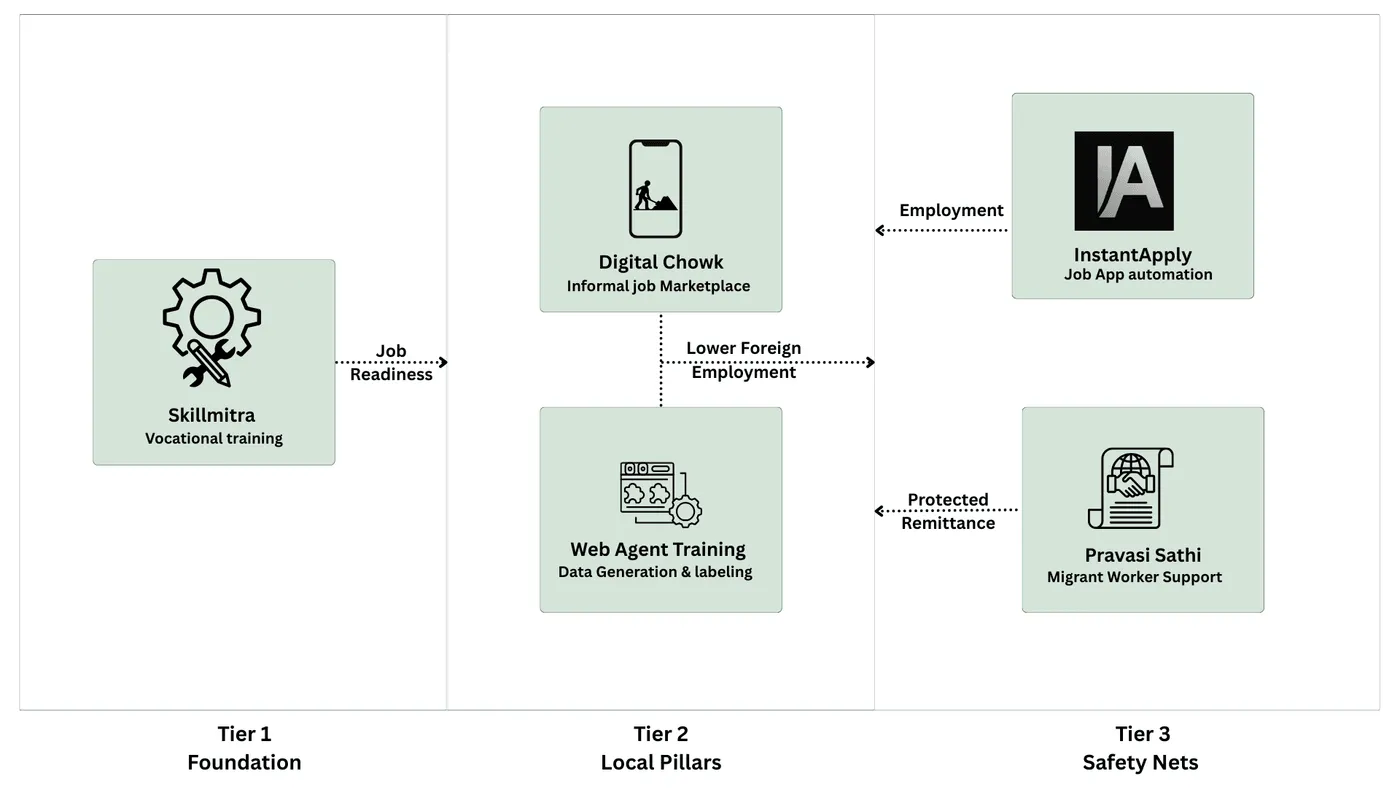
Figure 1. The five projects and how each tier is meant to feed the others.
Each tier is designed to strengthen the others. SkillMitra training produces better-prepared workers for Digital Chowk. Digital Chowk jobs reduce the pressure to migrate. Pravasi Sathi protects those who still leave. InstantApply revenue pays for technology jobs in Nepal. No single app spans the gaps that geography and politics create; the claim of this paper is that a locally owned set of connected tools can.
Most of this is still a prototype. Two of the five tools have not been deployed with real users, one has not yet produced any paid work, and the links between the tiers are a design, not a measured result. The limitations section says so in detail.
Introduction: the crisis of mobility
Every day, over 2,000 Nepali citizens board planes bound for foreign employment (DoFE, Government of Nepal, 2025). They leave behind families, communities, and a country that cannot employ them. Nepal’s diaspora now exceeds 4.5 million, in a nation of 30 million (Panthee, 2024). Remittances are worth over 25% of GDP (World Bank, n.d.).
Why does a country with a young, motivated labour force export that labour force rather than employ it? The development economics literature on landlocked nations points to geography: countries without sea access face higher trade costs, less foreign investment, and a narrower range of viable economic strategies (Collier, 2007; Faye et al., 2004). Nepal’s version of this constraint is among the most severe in the world, because virtually all of its trade depends on a single neighbour for transit. But geography alone does not explain Nepal’s position. Bhutan shares Nepal’s Himalayan landlockedness and its dependence on India, and has a GDP per capita nearly three times higher (World Bank, 2024).
Political economy research points to a second factor. Since the transition to a republic in 2008, Nepal’s governance has been characterised by what Lawoti (2010) describes as a “syndicate system”, in which three parties rotate power while cooperating to exclude new entrants. Nepal’s score on Transparency International’s Corruption Perceptions Index has stayed at or below 35 out of 100 under every type of regime since the index began tracking it (Transparency International, 2012–2024), which suggests corruption is structural rather than the fault of individual leaders.
I use economic mobility as the central lens: the ability to acquire marketable skills, find paid work, and move between economic tiers without being blocked by geography, political patronage, or lack of information. By this definition, Nepal’s crisis is not primarily one of poverty, though poverty is severe, but of immobility.
The question is whether any class of intervention can work despite these barriers. I argue that digitalisation can: not as a single solution, but as a set of targeted tools, each built to lower a specific cost for a specific group of people. The paper sets out the diagnosis (Chapters 1 and 2), the case for digital tools (Chapter 3), the five projects (Chapter 4), the ethical tensions they raise, and their limitations.
Phase 1: The diagnosis
Chapter 1. The structural trap: landlockedness, transit costs, and a captive economy
1.1 Landlocked and captive
Nepal is one of thirty-two landlocked developing countries (LLDCs) recognised by the United Nations. Lack of territorial access to the sea constrains their integration into world markets, inflates the cost of trade, and limits the range of viable economic strategies (United Nations, n.d.). Nepal faces an unusually severe version of this constraint.
To the north are the Himalayas. China is close on the map, but it is separated from Nepal’s population centres by passes above 5,000 metres, which makes overland trade prohibitively expensive. India, by contrast, shares an open border with the southern Terai, where most Nepalis live. The result is that virtually all of Nepal’s international trade (imports, exports, and transit goods) passes through Indian territory.
This dependency goes beyond economics. When India’s interests align with Nepal’s, the open border eases trade and movement. When they diverge, Nepal is captive.
1.2 The 2015 blockade
In 2015 Nepal promulgated a new constitution. India objected, on grounds related to the representation of Madhesi communities in the Terai, and imposed an unofficial blockade on fuel, medicine, and essential goods at the border. It lasted months. Prices surged, hospitals ran short of supplies, and schools closed. Daily life for millions was disrupted not by internal conflict but by a neighbour’s displeasure with a sovereign political decision (Knowler, 2016).
The UN Convention on the Law of the Sea (1982) requires coastal states to give landlocked nations transit through their territory. The requirement is clear; in practice there was no way to enforce it. The blockade eventually eased through diplomacy, but the lesson stayed: Nepal’s economy operates at the discretion of its southern neighbour, and conventional domestic policy cannot fully remove that vulnerability.
1.3 The economy in comparative perspective
In an earlier paper, Comparative Economic Development in Landlocked Nations, I compared Nepal with Bhutan and Laos to see how landlockedness interacts with other structural factors.
| Nepal | Bhutan | Laos | |
|---|---|---|---|
| GDP per capita (US$) | 1,377 | 3,711 | 2,066 |
| Recent GDP growth | about 3.9% | not given | about 7% |
| What the comparison attributes it to | consumption funded by remittances | stable institutions; hydropower exports to India | infrastructure, mining, hydropower; five neighbours to trade through |
Table 1. Three landlocked economies. GDP per capita and Nepal’s growth: World Bank (2024). Laos’s growth: Moody’s Analytics (2024).
All three countries share mountainous geography, limited industrial bases, and dependence on larger neighbours. Yet their trajectories differ sharply.
Bhutan’s relative prosperity reflects stable institutions, specifically a constitutional monarchy that transferred power peacefully in 2008, and its management of hydropower exports to India. Its Gross National Happiness framework is sometimes dismissed as symbolic, but it is a coherent development philosophy that has attracted targeted foreign investment and preserved institutional continuity. Laos, despite authoritarian governance, has reached GDP growth near 7% through infrastructure investment, mining, and hydropower along the Mekong corridor (Moody’s Analytics, 2024). It borders five countries, including Thailand and Vietnam, which gives it a diversity of trade routes that Nepal lacks.
Nepal’s growth of about 3.9% is lower and also different in kind. It is driven not by productive domestic capacity (manufacturing, technology, or modernised agriculture) but by consumer spending funded by remittances (World Bank, 2024).
1.4 The measurement problem
Even these GDP figures carry an asterisk. The informal sector accounts for roughly 40% of GDP by one recent estimate, and more by others (The Kathmandu Post, 2024): workers, transactions, and economic relationships that sit outside formal measurement. When that much of an economy is invisible to the instruments designed to measure it, policy built on that data is imprecise.
1.5 The remittance-driven structure
The Solow growth model identifies capital accumulation, technological progress, and labour growth as the drivers of long-run growth. Nepal is constrained on all three: capital accumulation is limited by geography and weak institutions, technology adoption is slow, and the most productive part of the labour force is abroad.
Remittances are the dominant input to Nepal’s economy. Over 4.5 million Nepalis work abroad, in the Gulf states, Malaysia, South Korea, Japan, and increasingly Europe and the Americas. Their earnings fund the consumer spending that drives GDP. But remittances are not investment. They sustain households; they do not build factories, train workers, or create the institutions that generate long-term productive capacity.
The Lewis dual-sector model describes structural transformation as the movement of labour from agriculture to modern sectors. In Laos that movement has been driven by mining and hydropower. In Nepal the movement has been largely geographic rather than sectoral: from the mountains to the hills, to the plains, to Kathmandu, and then to India, the Gulf, or the West. The economy has not transformed; it has offshored its labour force.
Chapter 2. The political trap: governance failure, corruption, and the remittance equilibrium
Bhutan shares Nepal’s geography and its dependence on India and has done markedly better. Much of the difference lies in institutional quality, and this is where Nepal’s political system holds back economic mobility.
2.1 The syndicate system
Since 2008, Nepal’s politics have been dominated by three parties: the Communist Party of Nepal (Unified Marxist-Leninist), the Nepali Congress, and the Maoist Centre. Their leaders (K.P. Sharma Oli, Sher Bahadur Deuba, and Pushpa Kamal Dahal) have served as Prime Minister three, five, and three times respectively. Power has rotated among them through coalitions formed, dissolved, and re-formed, in a pattern Lawoti (2010) describes as a “syndicate system”: a political cartel in which parties compete for office but cooperate to exclude new entrants.1
The pathways to power (party membership, patronage networks, caste and kinship connections) are controlled by the same leaders who have occupied them for decades. The system is formally democratic but functionally closed: elections occur, coalitions form, prime ministers change, and the underlying distribution of power and access stays the same.
2.2 Corruption as a structural feature
Nepal’s Corruption Perceptions Index scores have stayed in a low, narrow band, between 27 and 35 on a 0–100 scale where 100 is clean, under every regime since the index began tracking the country (Transparency International, 2012–2024). If corruption were only a matter of bad leaders, it should fluctuate when leaders change. If it were a matter of regime type, it should have improved as Nepal moved from monarchy to republic. That it has barely moved through all of these changes suggests corruption is embedded in the institutions themselves: in patronage networks, informal norms of political exchange, and the absence of enforcement independent of the political class.
For economic mobility the cost is direct. Access to opportunity is distributed through connections rather than merit or markets. A young person seeking a government job, a contractor bidding for a public project, or a migrant worker navigating the foreign-employment process all face a system in which formal rules matter less than informal networks of influence and payment.
2.3 The Remittance Trap: a systems analysis
In The Complexity of Discontent I used a causal loop diagram to explain how Nepal’s political and economic dysfunction produces a stable, self-reinforcing equilibrium. I call it the Remittance Trap.
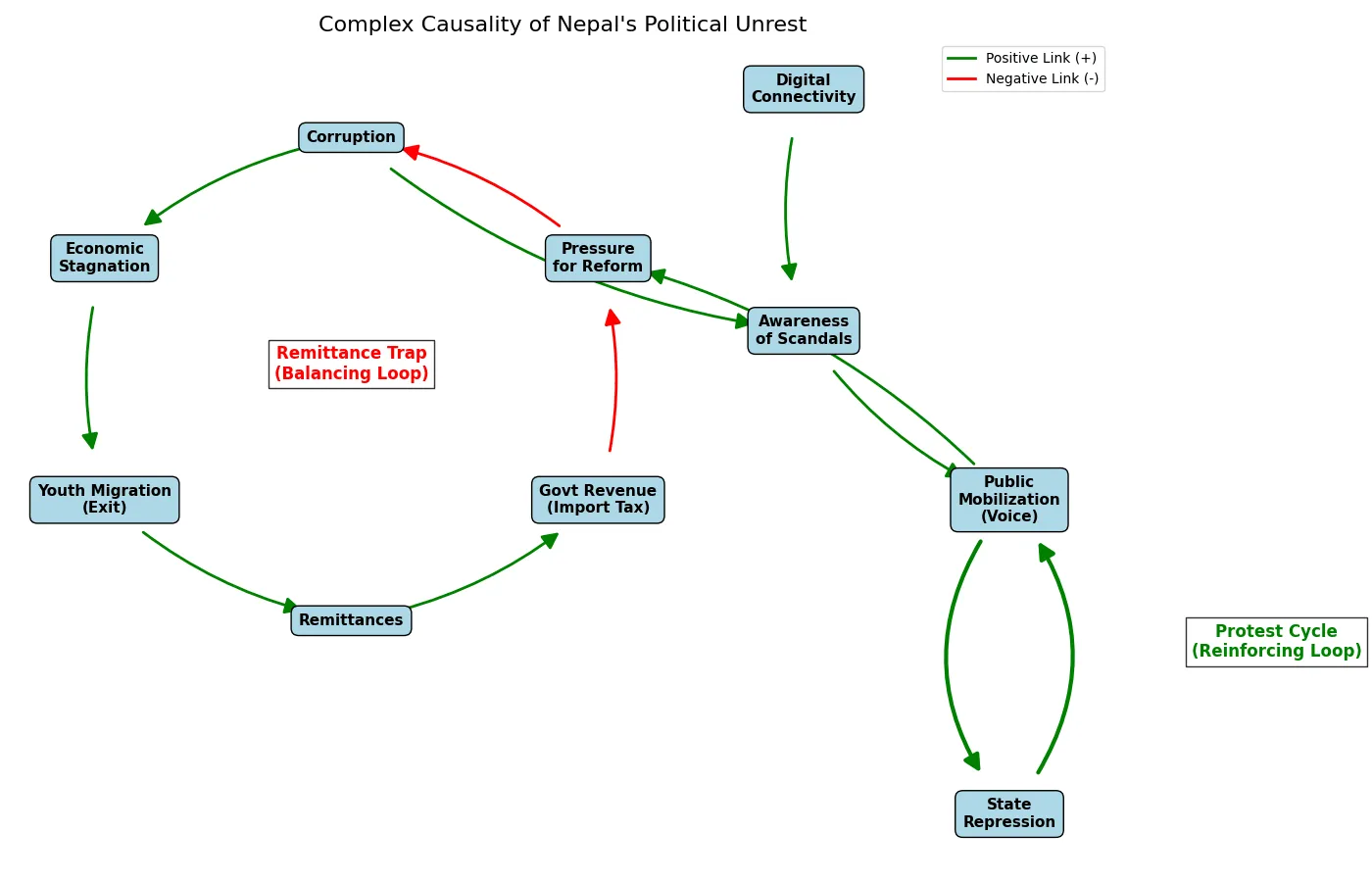
Figure 2. The Remittance Trap (left, a balancing loop) and the protest cycle that later disturbed it (right, a reinforcing loop). Green arrows are positive links, red arrows negative.
The loop works as follows.
- Corruption leads to economic stagnation. When opportunity is allocated through patronage rather than productivity, investment is misallocated, talent goes unrewarded, and the economy fails to create the jobs its population needs.
- Stagnation leads to youth migration. Faced with a labour market that offers too little, young Nepalis make the rational choice to work abroad. This is Hirschman’s (1970) “Exit”: leaving a system rather than trying to reform it.
- Migration generates remittances. Money sent home funds household consumption, which generates import demand, which generates customs and tax revenue for the state.
- Remittance-funded revenue reduces pressure for reform. As long as the state collects import taxes on remittance spending, it faces no fiscal crisis. The people most likely to demand reform (young, educated, frustrated) have left. The political cost of inaction falls.
- Reduced pressure lets corruption persist. The cycle closes.
This is a balancing loop. The system does not collapse under its own corruption because it has an escape valve. The workers who would otherwise be an unemployed, politically active population at home are dispersed across the Gulf, Malaysia, South Korea, and beyond, and their remittances sustain the system that failed to employ them.
2.4 The cost of exit
The diagram does not capture the human cost. Over 1,500 Nepali migrant workers die abroad each year (Sharma, 2025). Roughly 60% experience contract substitution: they sign one agreement in Nepal and discover on arrival that the job, the salary, or the conditions have changed (Amnesty International, 2017, p. 56). Deteriorating mental health is a serious and under-reported problem among Nepali workers abroad, and suicide is among the reported causes of death.
2.5 The Gen Z uprising
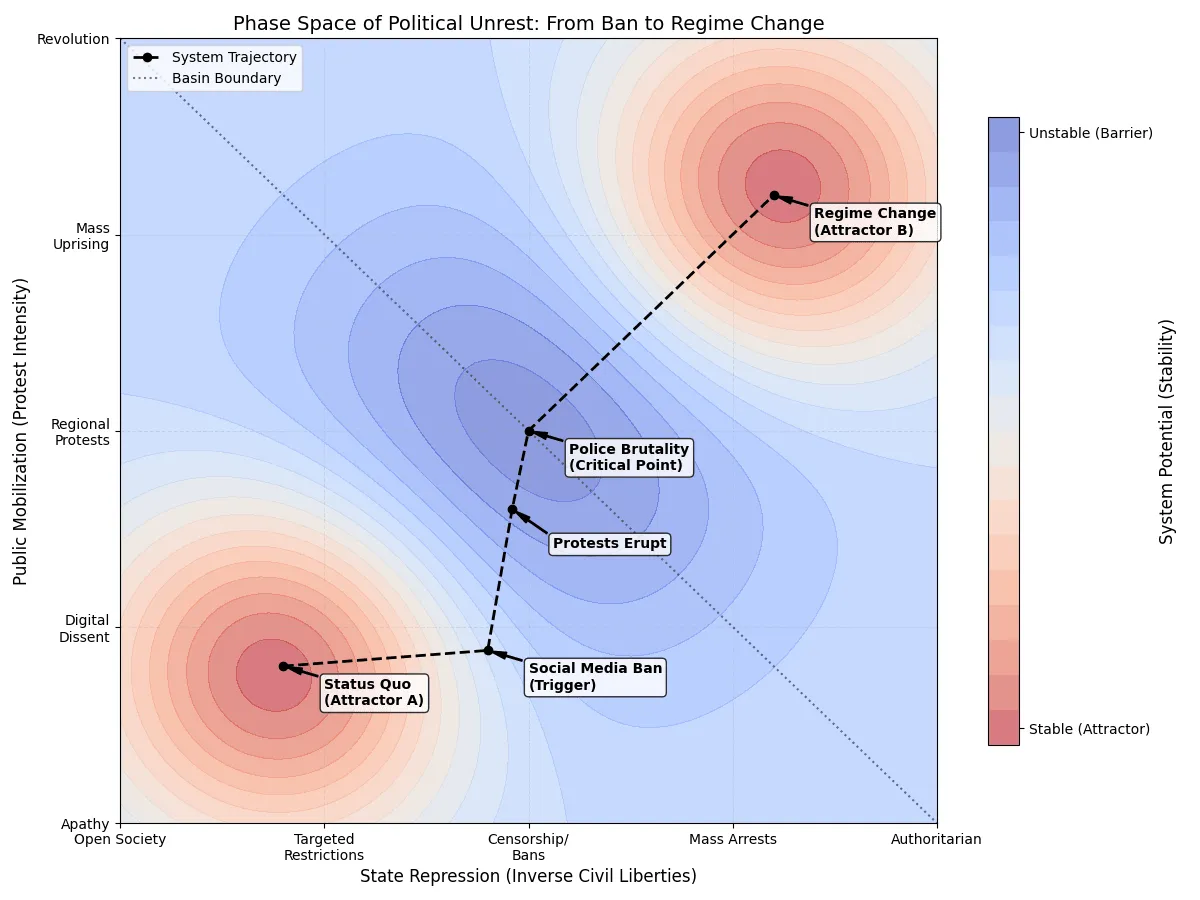
Figure 3. A conceptual phase-space diagram of the 2025 unrest. The system leaves the stable “status quo” basin when the social media ban raises repression, climbs as protests erupt, crosses a critical point when police violence makes a return to the old equilibrium impossible, and settles in a new basin.
Beginning around 2022 and escalating through 2025, a youth-led protest movement, widely called the “Gen Z” uprising, showed that digital connectivity had changed the cost of collective action and disturbed the Remittance Trap equilibrium.
Historically, the rational choice for a frustrated young Nepali was Exit. Organising collective political action (“Voice”, in Hirschman’s terms) cost too much. Social media changed that calculation. The cost of sharing information fell to nearly zero. Corruption scandals that were once hidden or local became nationally visible within hours. The “No Not Again” campaign in the 2022 elections, which urged voters to reject the established party leaders, was organised digitally, without party infrastructure, at minimal cost (Rana, 2022).
The electoral rise of the Rastriya Swatantra Party and of independent mayors such as Balen Shah in Kathmandu2 showed that Voice could produce results. The street protests that followed showed that the reinforcing loop of digital mobilisation (awareness leads to protest, protest to repression, repression to more awareness) was stronger than the state’s capacity to suppress it. The government’s attempt to ban social media backfired and increased mobilisation rather than quelling it (Sen & Tuladhar, 2025). The prime minister resigned.
This matters for my argument not as political narrative but as evidence of a principle: digital connectivity lowers transaction costs in political markets, just as it can in economic ones. If a smartphone and a social media account can lower the cost of collective political action enough to destabilise a three-party cartel, the same technology can lower the cost of collective economic action: finding work, acquiring skills, protecting migrant rights, and reaching global job markets.
Phase 2: The digital hypothesis
Chapter 3. Digitalisation as a catalyst
The diagnosis so far: Nepal’s economic immobility comes from the intersection of geographic entrapment, political dysfunction, and a self-reinforcing remittance trap that exports the people most likely to demand reform. This chapter argues that digitalisation is the mechanism best placed to disrupt these loops. The argument has three steps. First, Nepal’s barriers are at root cost barriers, which digital tools are well suited to lower. Second, evidence from elsewhere links digitalisation to the outcomes Nepal most needs. Third, the particular shape of Nepal’s constraints makes digital intervention the highest-leverage strategy available.
3.1 The barrier problem is a transaction cost problem
The barriers in Chapters 1 and 2 have a common structure: they impose transaction costs on economic activity. Transaction cost theory, which begins with Coase (1937) and was extended by Williamson (1985), holds that exchanges do not happen in a frictionless vacuum. Hiring a worker, learning a skill, sending money home, finding a customer, applying for a job: each carries search, information, bargaining, and enforcement costs. When those costs are high enough, exchanges that would benefit both sides simply do not happen.
If Nepal’s barriers are cost barriers, the logic of intervention becomes clearer. The task is not to remove the Himalayas or fix the party system. It is to lower the cost of economic activity despite them. That changes the question from “how do we reform Nepal’s institutions?”, which is a generational political project, to “how do we reduce the cost of finding work, acquiring skills, sending money, and getting information around those institutions?” Technology can make progress on the second question in the near term.
3.2 Evidence from elsewhere: investment, efficiency, employment
The claim that digitalisation lowers transaction costs is supported by evidence on three outcomes Nepal urgently needs.
Foreign direct investment. Digital infrastructure (broadband, e-governance platforms, digital payments) signals to foreign investors that a country can support modern business. Countries that have invested in it have seen measurable increases in FDI inflows (UNCTAD, 2024). For a landlocked country whose ports, highways, and railways are constrained by geography and chronically underbuilt, digital infrastructure offers another route to investment.
Government efficiency. Digitising public services (tax collection, land registration, identity verification, benefit distribution) reduces the bureaucratic friction that characterises Nepal’s governance. Estonia is the standard example: a country of 1.3 million that digitised virtually all government services and reduced both administrative cost and opportunities for corruption (Heller, 2017). Nepal is less centralised, more geographically fragmented, and has lower average digital literacy, but the principle holds. The argument for strengthening local governance after Nepal’s move to federalism, which I made in a paper on reforming foreign aid, could be put into practice through digital service delivery that does not require travelling to a provincial or national office.
Employment. This is the outcome closest to the diagnosis. In Digital Transformation of Government Investment Portals in Nepal I hypothesised that digitalisation would improve employment prospects and ease the country’s persistent brain drain. Two mechanisms support that. First, digital platforms create markets by lowering the cost of matching supply and demand, as ride-sharing and freelance marketplaces have shown. Second, digitalisation creates categories of work that did not exist before: data labelling, content moderation, remote customer support, and AI training. All of these can be done from anywhere with an internet connection, including a landlocked country with no port.
InstantApply offers a small-scale illustration. The modern job-application process can be read as a market failure: the “Easy Apply” button on platforms like LinkedIn created a negative externality, a flood of low-quality applications that pushed employers toward stricter algorithmic filters, which in turn pushed candidates to apply to even more jobs (Gonzalez & Stubberfield, 2024, p. 54). InstantApply automates the repetitive part of that process. Its early users averaged six interviews each. That is a small sample without a control group, but it is consistent with the idea that reducing friction in a labour market improves employment outcomes.
3.3 Why digitalisation fits Nepal’s barrier profile
The theoretical case applies to many developing countries. What makes it especially relevant to Nepal is that the alternatives are unusually slow or difficult there.
Physical infrastructure is blocked by geography. Nepal’s growth of about 3.9%, against roughly 7% in Laos, reflects in part how hard it is to accumulate capital in a country where a highway through the Himalayas costs far more than one through the Mekong corridor. In Laos, structural transformation was driven by mining and hydropower, sectors that need massive physical infrastructure. Nepal’s hydropower sector is emerging (Nepal Rastra Bank, 2024), but it cannot absorb the millions of young workers now choosing migration. Digital infrastructure needs only devices and connectivity, and both are spreading faster than roads.
Institutional reform is blocked by political dysfunction. The three-party syndicate and the remittance trap together form a stable equilibrium that resists change. Constitutional reform, anti-corruption enforcement, and a professional civil service are all desirable, but they need the cooperation of the actors who benefit from the current system. Digital platforms can operate outside the state. The Gen Z uprising showed this: social media bypassed traditional party structures and lowered the cost of collective action enough to make Voice a rational choice (Gautam et al., 2025, pp. 119, 123). If digital connectivity can disrupt the political system, it can also create platforms for skills, employment, and worker protection that do not depend on state capacity.
The target population is already connected.
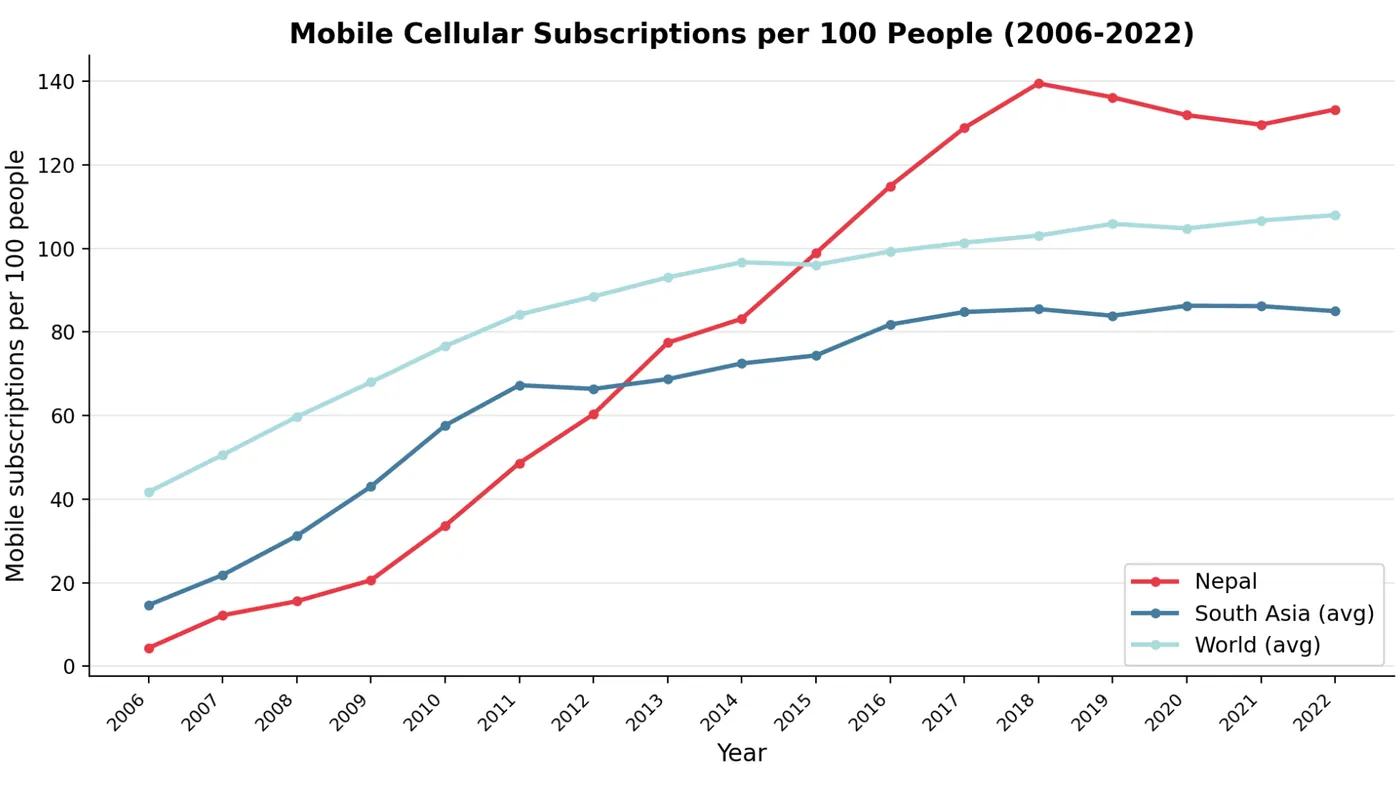
Figure 4. Mobile cellular subscriptions per 100 people: Nepal (red), South Asia average (dark blue), and world average (light blue). Values exceed 100 because one person can hold several subscriptions. Data: World Bank.
Mobile subscriptions per person in Nepal are above both the South Asian and the world average (Figure 4). The device is already in people’s hands. The open question is whether anyone builds and maintains the software that turns it from a tool for consumption (social media, entertainment) into a tool for earning (learning skills, finding work, protecting workers, sending money efficiently). This is what separates digitalisation from other infrastructure investments: the hardware does not have to be built first.
Phase 3: The ecosystem of solutions
Chapter 4. The Digital Bridge ecosystem
The response I propose is not a single application but an ecosystem: a coordinated set of tools, each built to lower one transaction cost for one population, and designed so that the effects of each compound the others.
4.1 The foundation: SkillMitra
Every later tier depends on Nepali workers having demonstrable, marketable skills. Skill acquisition is the upstream input without which the rest stalls.
Vocational training in Nepal has historically been supply-driven and hard to reach. Government programmes operate mostly in Nepali, assume classroom attendance in urban centres, and are aimed at formal-sector occupations, leaving out the large informal economy. My landlocked-nations paper documented an urban–rural literacy gap of 84% against 62%. For many of the people who most need training, existing programmes are geographically out of reach, linguistically mismatched, and unrelated to the informal work they actually do.
SkillMitra is my attempt to lower these costs. Its pipeline recommends courses based on a learner’s situation, produces text-based curricula, and converts them into more accessible media. It is designed around two AI-generated formats: spoken Nepali audio, and instructional videos generated with a sequential image-prompting technique. Audio makes training reachable for workers whose literacy would otherwise exclude them; video supplies the visual demonstration that manual skills require. An offline synchronisation layer lets learners download content when they have signal and study without it.
SkillMitra is the least mature of the five projects. The video pipeline works but produces slideshow-like motion, and my own fine-tuned Nepali speech model did not reach usable quality (details in Appendix B). It has not been tested with the learners it is meant for.
4.2 The local pillars: Digital Chowk and Web Agent Training
Breaking the Remittance Trap requires viable work at home: work that is available now, adequately paid, and reachable without the patronage networks the syndicate system demands. The local pillars attack the trap from the supply side by creating employment options inside Nepal that can compete with migration as a rational choice.
Digital Chowk: formalising the informal economy
A labour market already exists in Nepal, but it runs with enormous friction. Skilled workers (plumbers, electricians, painters, masons) are hired either by a phone call from someone who knows them or through the chowk system: they stand at particular street intersections and wait for contractors or homeowners to pick them in person. The worker has no way to signal availability other than being there, no way to show the quality of past work, and little leverage over wages. The employer has no way to verify competence before hiring, no recourse if the work is poor, and no way to find workers beyond a few city blocks.
The conversations I had with informal-sector workers in far-western Nepal raised three recurring concerns: the cost in dignity of waiting to be picked, the information gap that weakens workers in wage negotiations, and the exclusion of women, older workers, and people with limited literacy. Digital Chowk’s voice-first profiles, location-based availability, and transparent pricing were designed around those three points.
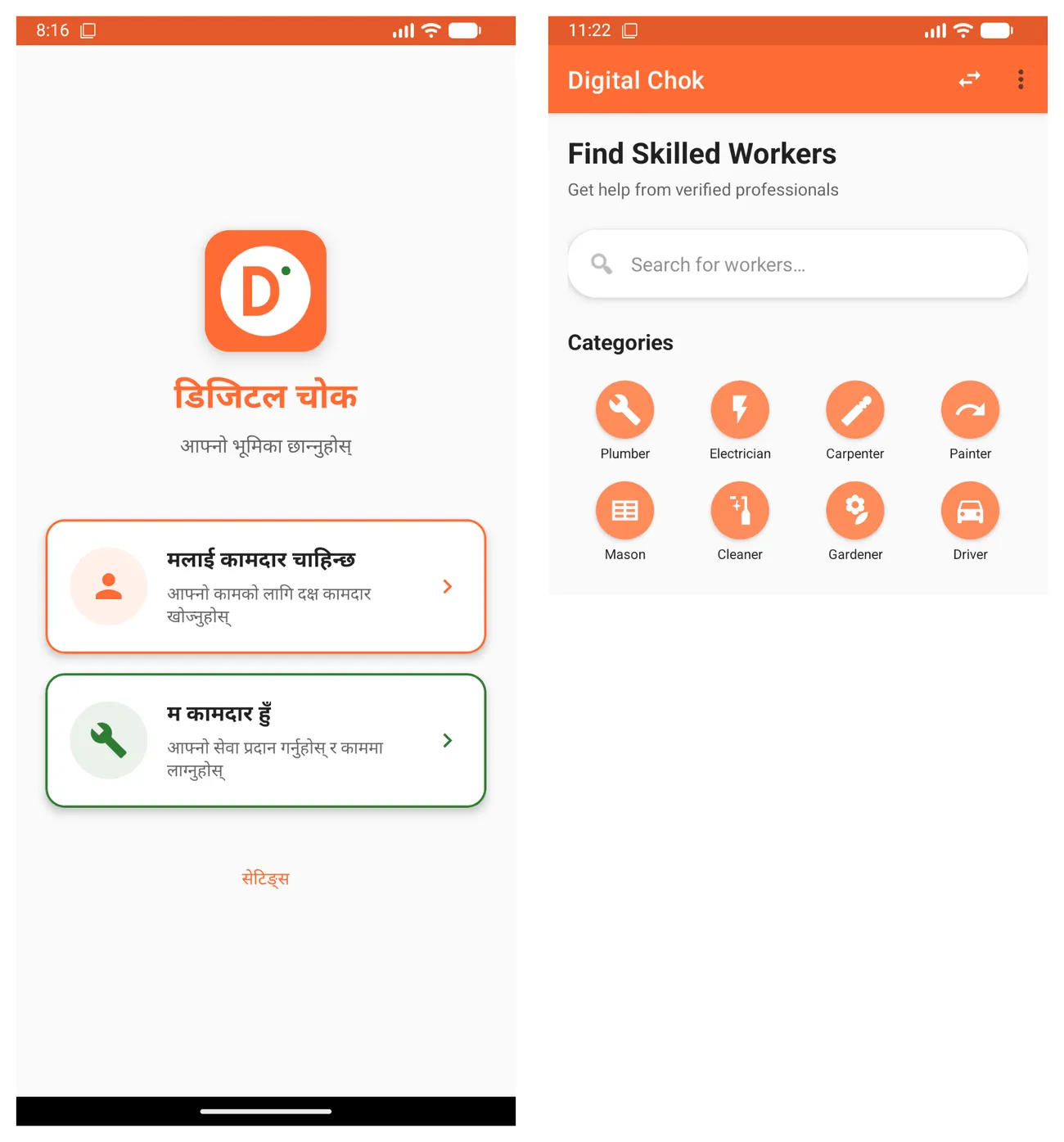
Figure 5. Digital Chowk: role selection in Nepali (left) and the customer’s search screen (right). The list of nearby workers below the categories is cropped out.
Digital Chowk is designed to remove these transaction costs without removing the market itself. Voice-first profile creation lets a worker with limited literacy build a professional identity by speaking rather than typing. Location-based availability replaces the physical chowk: a worker switches to “available” from home rather than standing on a street corner at dawn. A visual portfolio (photographs of completed work) provides the trust signal.
The equity implications matter. The physical chowk excludes those who cannot compete in the early-morning rush: women, older workers, workers with disabilities, and anyone who lives far from the main intersections. A digital system is meant to lower those barriers. In an economy where the informal sector is around 40% of GDP, making this sector work better raises the floor for the most economically vulnerable part of the labour force.
Web Agent Training: digital work as a domestic alternative
Digital Chowk formalises existing domestic work. Web Agent Training is aimed at a new category of domestic work: digital, connected to global demand, and available without migrating.
In growth-model terms, what Nepal is missing is technology-driven sectors that create employment without the ports, highways, and industrial zones that geography makes so expensive. Web Agent Training responds to that gap: it needs nothing beyond a browser and an internet connection.
For it I built a Chrome extension that assigns web tasks to a worker, records them carrying out each task, labels each recording with its task, and saves or uploads the result (Appendix B). The pipeline exists as working infrastructure. No one has been employed through it yet.
This kind of work shows both a promise and a problem. Pay for data work is low by US standards. Against Nepal’s alternatives, though, it can be a material improvement. Nepal’s GDP per capita is $1,377. Informal work, where most of the workforce is, pays daily wages that are inconsistent, weather-dependent, and physically demanding. Digital work done from home, with no commute, no exposure to weather, and no dawn competition for a place at the chowk, offers better conditions and more predictable income.
But there is a power asymmetry. Rates for this work are not negotiated between equals. They are set on the buyers’ side, by organisations with far more bargaining power than a first-time supplier in Nepal. The data these workers would produce trains AI systems worth orders of magnitude more than the wages paid to produce it. The workers would have no ownership stake in the models trained on their demonstrations, no intellectual property rights over their recorded behaviour, and no long-term contractual relationship that might improve as the value of their contribution became clear. I return to this under Ethical tensions.
4.3 The safety nets: Pravasi Sathi and InstantApply
Creating domestic alternatives does not end migration, and should not aim to. Over 4.5 million Nepalis work abroad. More than 2,000 leave every day. Remittances are worth over 25% of GDP, and in many rural districts they are the only source of household income. The goal is not to stop migration but to make sure that those who migrate do so by choice rather than desperation, with adequate information and access to protection.
The safety nets operate where the local pillars’ reach ends: where a worker has decided to enter the global labour market, because alternatives at home are not yet enough or because the opportunity abroad is better.
Pravasi Sathi: a digital guardian for migrant workers
The exploitation of Nepali migrant workers is systematic, not incidental. Recruitment (“manpower”) agencies routinely charge fees up to ten times the government-mandated rate (Fairsquare, 2021). Sixty percent of workers experience contract substitution: they sign one contract in Kathmandu and discover on arrival in Qatar or Malaysia that the job, the salary, or both have changed (Amnesty International, 2017, p. 56). Over 1,500 die abroad each year (Sharma, 2025). These are features of a system in which information asymmetry is the main mechanism of exploitation.
To understand how that exploitation works and which interventions would be most useful, I spoke with Nepali migrant workers in India and Malaysia and with returnees in Nepal,, by video call, over Facebook Messenger, and in person.
Those conversations shaped the feature set: contract checking before departure, documentation of wages and hours, transparent remittance rates, and a way to report incidents. Pravasi Sathi tries to reduce the information gap at each stage of the migration cycle. Before departure, its contract scanner uses on-device text recognition to read a photographed employment contract and flag warning signs (fees charged to the worker, salary discrepancies, missing clauses), and translates key terms into Nepali. Country guides for 20 destination countries give workers a baseline for wages, working conditions, customs, and legal rights. A pre-departure checklist covers documents, insurance, and emergency contacts.
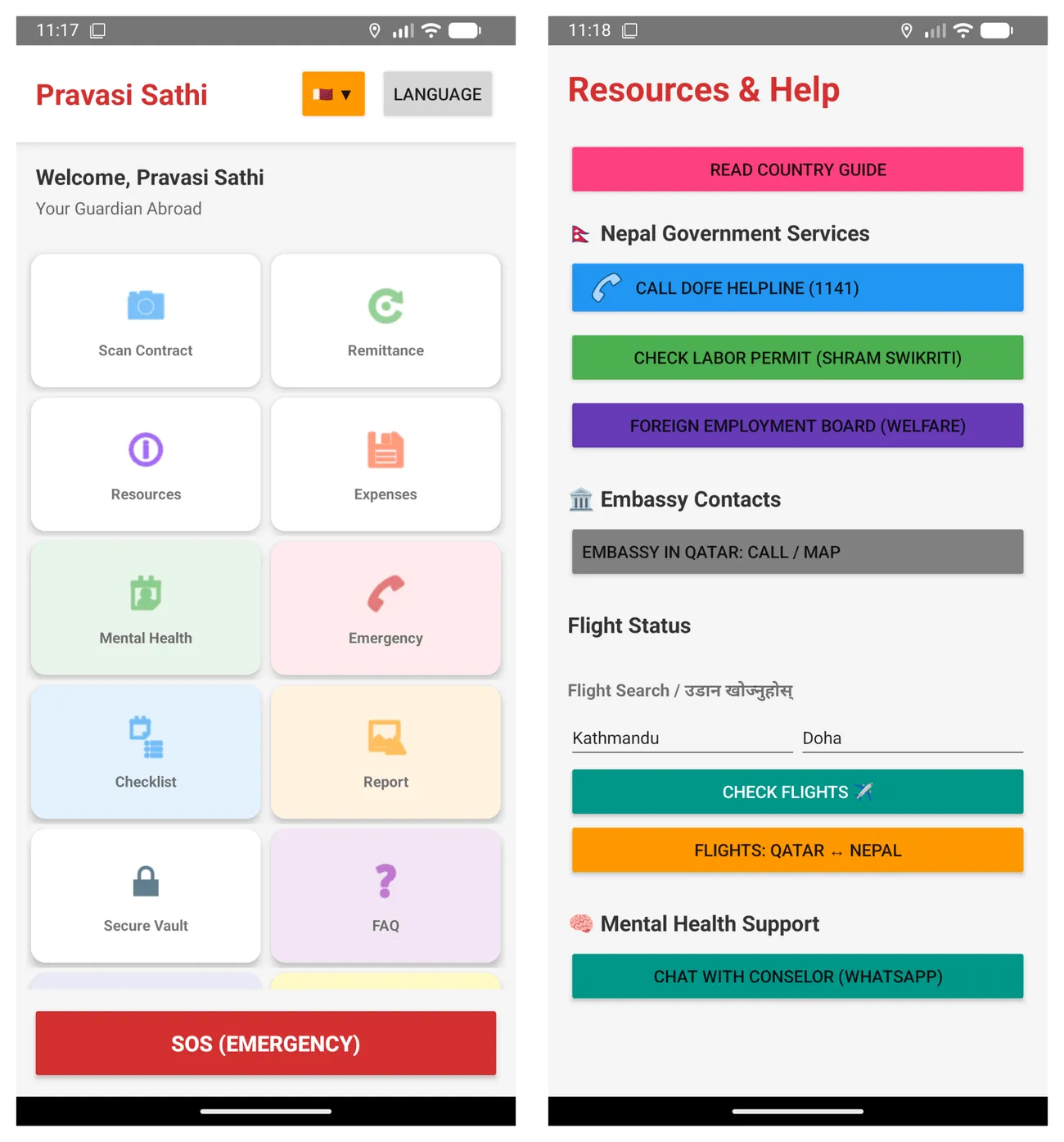
Figure 6. Pravasi Sathi: main dashboard (left) and the resources page for a worker in Qatar (right).
During employment abroad, the safety net tightens. An SOS button sends an SMS with the phone’s GPS coordinates to the worker’s designated emergency contact; contacts can include family, the embassy, or a labour attaché. It uses SMS rather than mobile data because workers in a crisis often have no reliable connection. An expense tracker and a remittance calculator help workers see what a transfer should be worth, so they can compare it with what informal hundi channels offer.
The app is built to be privacy-first and usable offline. Documents are stored in an encrypted vault on the device, at the cost that users lose them if they change phones. The interface is visual and in Nepali by default.
InstantApply: automating access to the global job market
If Pravasi Sathi protects workers entering low-wage international labour markets, InstantApply serves the complementary group: educated Nepalis seeking white-collar work in global markets, the group most associated with brain drain.3 Job seekers spend an average of 113 hours on the application process (Fennell, 2024), and the market shows classic signs of information asymmetry and high transaction costs. For international applicants the costs are higher still: unfamiliar application norms, time zones, and the volume of tailoring each application needs.
User interviews pointed to the same pain points across international job seekers: time lost to repetitive data entry, uncertainty about visa sponsorship, a limited professional network, and difficulty tailoring materials without knowing the market.
InstantApply automates the application process with an AI-driven agent that edits résumés, drafts tailored cover letters, and submits applications, replacing most of the manual data entry with one preferences form. A keyword-matching recommendation step pairs candidate profiles with job requirements so that automation does not come at the cost of relevance. The service reached just over 20 paying users, who averaged six interviews each: early evidence, from a small sample, that it lowers the cost of taking part in the global job market.
The design choice that matters most for this paper is what I call the Nepal Advantage: a human-in-the-loop moderation layer staffed entirely by workers in Nepal. The moderators coordinate the different sub-applications and review automated output before it is submitted. The quality-assurance work is done at Nepali labour costs while serving clients in the US job market. The effect is a loop that connects the global tier back to the domestic economy. InstantApply sells access to international opportunities and, in doing so, creates technology-sector jobs in Nepal. It is a safety net for global job seekers and, through its operating model, also a local pillar: one concrete case of one tier producing effects in another.
InstantApply was co-built with my co-founder. I built the résumé module, the email monitor, the Chrome extension, and an NFC business-card app on my own, and handled cloud deployment, contractor management, and university outreach. My co-founder led front-end design, job sourcing, and much of the marketing. The autofill agent, the recommendation set-up, incorporation, pitching, and customer support were shared.
4.4 The connecting logic: from projects to ecosystem
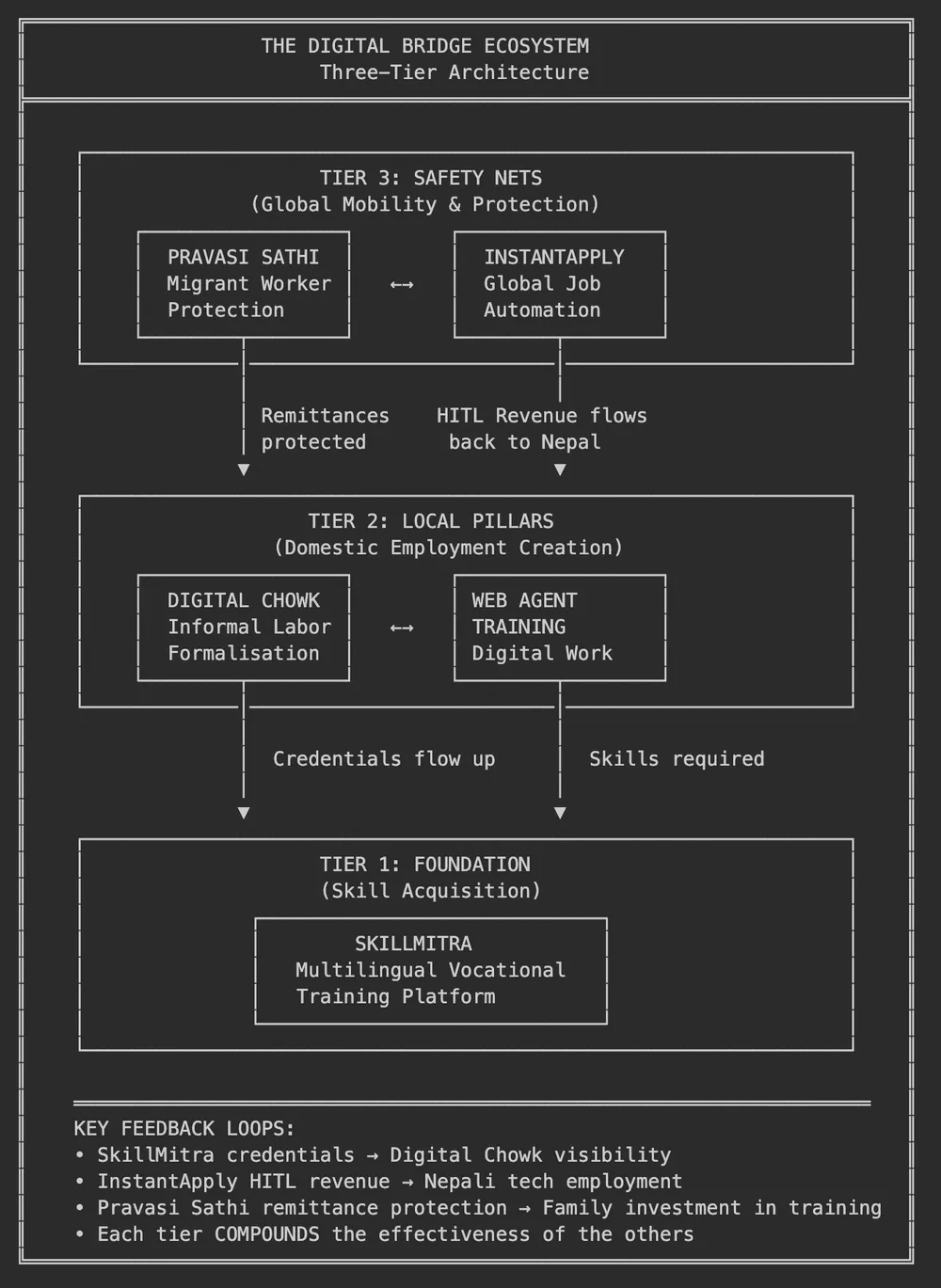
Figure 7. The three tiers and the intended feedback loops between them. HITL = human-in-the-loop.
The value of the ecosystem is meant to lie in the connections rather than in any single tool.
SkillMitra improves the supply side of Digital Chowk by producing workers with verifiable training, which should increase employer trust, platform adoption, and the domestic employment base. Digital Chowk and Web Agent Training reduce the need for Pravasi Sathi by offering alternatives to migration. For those who still leave, skills from SkillMitra and digital literacy from data work make them better-prepared migrants, more able to use Pravasi Sathi’s contract scanner and salary tracker.
InstantApply’s human-in-the-loop operations create a new kind of local-pillar job and close the loop between the global and domestic tiers: revenue from job seekers in the US pays moderators in Nepal. And Pravasi Sathi’s remittance tools are meant to raise the return on migration, so that more of a worker’s earnings reach a family that can invest in training for the next generation.
The matrix below maps each barrier from Chapters 1–3 to what each project does about it.
| Barrier | SkillMitra | Digital Chowk | Web Agent Training | Pravasi Sathi | InstantApply |
|---|---|---|---|---|---|
| Geographic isolation / landlockedness | Offline sync, multilingual audio | GPS-based availability | Remote digital work via browser | Country guides for 20 nations | Global job market access |
| Political corruption / syndicate system | Bypasses patronage-based training | Merit-based visibility | Non-political employment | Anti-corruption contract scanning | Bypasses local hiring networks |
| Institutional weakness | Self-directed learning | Direct worker–client connection | Direct buyer–worker contract | Supplements weak consular services | Bypasses weak career services |
| Remittance dependency / “Remittance Trap” | Creates domestic skills | Creates domestic employment | Creates domestic digital employment | Protects remittance value | Routes revenue back to Nepal (HITL) |
| Information asymmetry | Course recommendations | Worker portfolios, ratings | Transparent task-based work | Contract scanner, salary tracker | AI-matched applications |
| Skill deficits | Primary function | Leverages SkillMitra credentials | Requires basic digital literacy | Pre-departure checklists | Résumé optimisation |
| Migration exploitation | — | Domestic alternative to migration | Domestic alternative to migration | Primary function | — |
| Digital divide | Offline-first, audio-first | Voice-first profiles | Browser-only requirement | Low-bandwidth design | Web-based platform |
| Gender / inclusion gaps | Multilingual access | Removes physical chowk barriers | Location-independent | Women-specific protections | — |
Table 2. Synthesis matrix: barriers × projects. Each cell is the design intent of that project, not a measured effect.
Ethical tensions
Web Agent Training: empowerment or exploitation?
The tension between economic improvement for workers and structural extraction by buyers runs through the whole global data-labelling economy.
The case for empowerment rests on comparing like with like. The relevant comparison is not between a data-work rate and a Silicon Valley wage but between that rate and the realistic alternatives open to a young Nepali worker today: informal labour at the chowk (unstable, physically demanding, and corrosive to dignity), migration to the Gulf (exploitative, dangerous, and far from family), or unemployment mediated by partisan patronage. Against those options, digital data work is safer, more flexible, more dignified, and easier to combine with study. It builds digital literacy. It keeps workers inside the national economy. It creates a workforce with transferable skills that can lead to better-paid work as Nepal’s technology sector matures. To dismiss this as exploitation from the standpoint of a Western wage is to impose an outside moral frame that may argue against the jobs Nepali workers themselves would choose.
The case for exploitation rests on structure. The wage is not low because the work is low-value; it is low because the workers are in Nepal. The business model depends on geographic wage arbitrage, the same logic behind outsourced call centres, textile manufacturing, and the migrant labour that Pravasi Sathi exists to protect. That the arbitrage is digital rather than physical does not change its shape: value flows up from low-wage economies to high-wage ones, and the workers who create it capture a fraction. Data labelling is also precarious. Contracts can end overnight, tasks can be automated away by the very systems the data trains, and workers have no collective bargaining power. A data-labelling workforce in Nepal could, if not carefully governed, reproduce the dependency the Remittance Trap describes.
Both analyses are correct at once. The wage is better than today’s alternatives, and it reflects a structural inequality that should not be accepted as permanent. The work builds real skills, and it creates disproportionate value for the buyer. Staying in Nepal to do digital work avoids the dangers of Gulf migration, and it substitutes one form of labour arbitrage for another.
InstantApply: the pay-to-win dynamic
InstantApply automates job applications for a fee. If the service costs money, wealthier candidates can flood employers with polished automated applications while lower-income candidates are left behind. The tool could worsen the inequality it claims to reduce.
- Counter-argument. The current system is already biased toward people with time, who are often the wealthy or those without caring responsibilities. A student working 20 hours a week to pay tuition cannot spend 113 hours on manual applications. Lowering the cost of applying may level the field for time-poor applicants.
- Tragedy of the commons. If everyone uses an automated agent, employers are flooded and the hiring system may break. InstantApply’s relevance matching is designed to prevent indiscriminate applications, but the aggregate effect of widespread automation on employer filtering remains an open risk.
- Environmental cost. Rewriting thousands of résumés and cover letters with large language models has a real inference cost and carbon footprint, which should be monitored. Better recommendations would cut irrelevant applications but would not remove the concern.
Pravasi Sathi: privacy and responsibility for data
Pravasi Sathi handles some of the most sensitive data in the ecosystem: employment contracts, GPS location (through the SOS feature), salary records, work hours, expenses, and distress signals. Its users are migrant workers with limited legal standing in foreign countries, among the most vulnerable people one could build software for. The app is not yet deployed, and user data is currently stored on the device. Text recognition for contract scanning runs on the device, but the deeper analysis step sends extracted text to a hosted language model. To close that gap I may need to run a local model on the phone, as Apple does for message summaries, at the cost of more storage and memory.
Digital Chowk: platform precarity and the gig-economy trap
Digital Chowk makes skilled informal workers visible, searchable, and bookable by phone. The equity benefits are significant, but formalising work through a platform brings risks that the gig-economy literature documents well.
- Platform dependency. If Digital Chowk became the main way workers find jobs, the platform would gain leverage over the people it was built to serve. Ranking algorithms and changes to terms of service can reshape a market in favour of platform revenue over worker welfare.
- Misclassification. Digital Chowk connects workers to clients; it does not employ them. That mirrors the informal market, but it also means no benefits, no insurance, no sick leave, and no recourse if a client refuses to pay.
- Algorithmic fairness. Ratings, reviews, and any future AI-based ranking must be guarded against biases that would reproduce the exclusions of the physical chowk by favouring younger workers, men, or those with more polished digital profiles.
- Mitigation. The platform should commit to worker-governed feedback on algorithm changes and to dispute resolution that requires no more digital literacy than the voice-first interface does.
SkillMitra: access and the legitimacy of credentials
SkillMitra requires a smartphone and intermittent internet. Workers with neither, the most marginalised, remain excluded; offline sync narrows the gap but does not close it, and could deepen the digital divide. If employers do not recognise SkillMitra certificates, the platform offers the appearance of mobility without the substance. Recognition by industry bodies, government agencies, or employers is necessary for the credentials to mean anything. Automatically generated training content also has to be quality-controlled, especially for safety-critical trades such as electrical work, plumbing, and construction.
Phase 4: Synthesis and reflection
Chapter 5. Limitations and future work
5.1 Limitations of the projects
I have made hypotheses and claims about what these tools could do. They do not yet have those effects, or are incomplete.
Small samples. InstantApply’s roughly 20 paying users and average of six interviews are an early signal of demand, but the sample is far too small to generalise from. The user base is mostly computer science students; whether the service works as well for non-technical roles or for applicants without strong credentials is untested.
Undeployed prototypes. Digital Chowk and Pravasi Sathi are functioning applications, but neither has been deployed at scale with real users. My claims about their effect on friction in informal labour markets and on protection for migrant workers rest on analysis of the barriers they target, not on measured outcomes. The distance between a working prototype and a tool that changes behaviour in the real world is large and should not be understated.
No paid work yet. The Web Agent Training pipeline works as technical infrastructure, but its purpose, creating data-labelling jobs in Nepal, is unrealised: no one has been employed through it.
SkillMitra’s early stage. SkillMitra is the least mature project. Parts of its audio generation, offline sync, and recommendation engine are implemented, but it has not been tested with the low-literacy, rural learners it is designed for. Whether audio-based vocational training can match classroom instruction is an empirical question this paper does not answer.
The links between tiers are theoretical. The central argument, that the projects form a pipeline in which each tier compounds the others, has not been validated. That a SkillMitra graduate will join Digital Chowk, or that InstantApply’s moderation revenue will sustain technology jobs in Nepal, is a design intention, not a measured outcome as of March 2026.
5.2 Technology cannot replace institutions
More fundamentally, this ecosystem cannot substitute for what only institutions can provide. Anti-corruption enforcement needs a judiciary free of political influence. Constitutional reform needs political actors willing to limit their own power. Roads, electricity, and clean water need capital investment that no app can generate. Leverage over transit access through India needs geopolitical capacity that Nepal has historically lacked.
Technology can route around dysfunctional institutions in the short term. It cannot replace functional ones in the long term. The digital bridges described here are designed to work around the barriers, not to remove them. Removing them is a generational project of policy reform, institution-building, and political will that is beyond the scope of this paper.
5.3 Future work
The most immediate priority is deployment and user testing. I need to put Digital Chowk and Pravasi Sathi in front of real users and learn whether my design assumptions hold in the field. I expect the answer to require significant iteration.
I also plan to look for more opportunities like Web Agent Training. The goal is not data labelling specifically but more stable employment in Nepal in general, and I intend to use my connections and my experience working with corporate customers to find leads and secure contracts.
The most important future work is also the hardest: measuring impact over time. I need to track whether SkillMitra training leads to employment, whether using Digital Chowk raises income, whether using Pravasi Sathi reduces exploitation, and whether the connections between the tools produce the compounding effects the model predicts. That requires partnerships with researchers, NGOs, and possibly government agencies willing to run rigorous longitudinal studies.
Finally, if the ecosystem is to be locally owned in a meaningful sense, governance cannot rest with me alone. Future development should explore cooperative models, community advisory boards, or open-source structures that share ownership and decision-making with the people the tools serve.
Conclusion: building digital bridges
This paper began with a paradox: Nepal produces millions of ambitious, capable young workers and cannot employ them. Over 2,000 leave every day. Remittances are worth over 25% of GDP by World Bank measures (World Bank, n.d.). The state has failed to generate domestic employment, and the resulting migration sustains that state through a Remittance Trap that exports dissatisfied people before they can demand reform.
This is not a single problem with a single cause. Nepal’s immobility is produced by interlocking barriers: landlockedness that makes every physical transaction more expensive, corruption that distributes opportunity through patronage, institutional weakness that absorbs aid and reform alike, and a remittance-driven economy that has learned to function without developing domestic productive capacity. These barriers reinforce one another. A solution that addresses only one will be absorbed by the others.
The Digital Bridges framework answers a systemic diagnosis with a systemic intervention. The theoretical case, grounded in transaction cost economics and evidence on digitalisation, is that digital tools are not a luxury for a developing economy but the available lever: the one class of intervention that is not blocked by geography, depends less on state capacity, and is harder for political dysfunction to capture. SkillMitra, Digital Chowk, Pravasi Sathi, and InstantApply sketch what this looks like in practice: connecting talent with opportunity directly rather than through traditional gatekeepers. They operate outside the syndicate system. Software is cheap to extend to each additional user. And they reach people through a device they already own. Identifying the right tool is only the first step, however. Building the infrastructure to use it takes collective effort.
A call to action
This ecosystem is a prototype. It is what I, a Nepali undergraduate in computer science and economics, could study and build over four semesters. It is incomplete, imperfect, and early.
A dedicated group could build, deploy, and maintain something far more complete. Nepal lacks the support systems, the bridges, that connect talent and ambition to opportunity without requiring people to leave the country to find it, or to risk their lives once they do.
Building those bridges is not a task for one developer, one start-up, or one app. It needs communities of technologists, educators, policy advocates, and returning members of the diaspora who understand that the problem is systemic and are willing to build systemic responses: coordinated, locally owned, self-sustaining digital infrastructure that addresses the barriers together, the way the barriers themselves operate. I invite Nepali students, developers, and the wider diaspora to take ownership of the problem and collaborate on an ecosystem of tools.
Acknowledgments
Prof. Watson, my capstone advisor, and Prof. Hadavand guided InstantApply and the wider capstone process. Prof. Watson’s flexibility in letting me follow my interests, from working only on SkillMitra (my first proposal), to growing InstantApply’s user base, to this broader project on economic mobility in Nepal, helped me expand my skills and find meaning in the work. The paper draws on several courses I took over four years, and several of the papers written for them are published alongside it. I also thank my co-founder, our board director, my capstone class, and the co-workers who helped shape InstantApply and this project.
A note on positionality. I am a Nepali citizen, a computer science and economics student at Minerva University, and the builder of each project described here (InstantApply was co-built with my co-founder). This is not a detached policy analysis. It is an attempt, grounded in both research and engineering, to build practical responses to barriers I have seen first-hand: in the stories of migrant workers from my home district, in the daily reality of the chowk, and in the job-market friction I have navigated myself as an international student. The analysis aims for rigour; the motivation is personal.
Appendix A. How InstantApply was evaluated
Before charging for InstantApply, my co-founder and I surveyed 31 potential users, mostly students and new graduates, about their job-search process, pain points, existing tools, time spent, and how they tracked outcomes. We then ran the full application process for a single first user, staying in constant contact (more than 200 messages), before opening to others.
The pilot. I evaluated InstantApply with a pilot of 20 beta users. The intervention was the application method: automated agent submission instead of manual data entry. The main outcome was the number of interviews; secondary measures were employer response rate and time to first response. Users kept the same target roles, locations, and base résumé. The design was a single-group before-and-after comparison against each user’s own history of manual applications. Users averaged six interviews, about three times their baseline.
Why this is not proof. There was no concurrent, randomised control group applying manually over the same period, so I cannot establish causation. Users may have become better at interviewing or networking during the test (maturation), and shifts in the tech job market could have raised interview volume independently (history effects).
Who was in it. The 20 users were a convenience sample drawn from my university and my LinkedIn network: overwhelmingly computer science students with high digital literacy and strong English. That introduces selection bias and limits how far the six-interviews result generalises.
What a proper test would look like. Randomly assign a stratified cohort of about 100 job seekers (stratified by field of study and university tier) to manual applications or to InstantApply, and run both groups concurrently over a fixed 60-day period.
Revenue across the initial cohorts was approximately $800, of which $529 came in the first two weeks after the paid launch in July 2025. I paused acquisition after just over twenty paying users to iterate on the product.
Appendix B. The five projects: technical notes and code
The capstone’s technical appendices run to about thirty pages of architecture detail. This is a summary; the repositories have the rest.
InstantApply
Code: InstantApply · IA_email_checks
InstantApply began at a hackathon in San Francisco in March 2025. My co-founder and I, both international students in the middle of internship applications, were building AI agents at the weekend while acting as “human APIs” in our own job searches, copying the same information into dozens of portals. It grew from that weekend project into an incorporated start-up with paying users. Setting it up as international students meant incorporating a US C-Corporation, obtaining Curricular Practical Training authorisation, writing a co-founder agreement, and drafting contractor agreements for the moderators in Nepal.
The product has five parts:
- Profile and dashboard. A React front end where the user enters education, experience, skills, and preferences once, including visa sponsorship needs.
- Job sourcing. Aggregates listings from several job APIs and filters them against the profile, with a visa-sponsorship filter for international students.
- The agent. Browser automation (Playwright) that navigates applicant-tracking systems such as Greenhouse, Lever, and Workday, fills forms, uploads documents, and submits. Cases it cannot handle (unusual layouts, CAPTCHAs, multi-step verification) are flagged for a human rather than failing silently.
- Email monitor. Checks users’ inboxes, with their authorisation, for interview invitations. A two-stage filter removes vague automated confirmations and aggregator spam; keyword and context signals then produce a confidence score, and anything above 60% is flagged. It is tuned for recall, on the model of a network intrusion detection system: a false alarm is cheaper than a missed interview.
- Résumé editor. A React and TypeScript application with a small proxy server that keeps the language-model API key out of the browser. It imports PDF and DOCX résumés, restructures them, compares them against a pasted job description, and suggests rewrites of individual bullet points. Every AI suggestion needs explicit user approval because of the risk of hallucination.
The back end is a Flask application with a SQL database, deployed on Azure with continuous integration. Human moderators in Nepal, recruited and trained on data privacy, the US job market, and applicant-tracking conventions, review automated output before submission and double as customer support.
Web Agent Training
Code: pipeline_web_extension
A Chrome extension for collecting human demonstrations of web tasks. A task designer writes a plain-text list of tasks (for example, “Navigate to Amazon and search for ‘wireless headphones’”). The worker signs in, reads a task, presses Start, and performs it while the extension records the screen and the worker’s spoken explanation of their reasoning. On Stop it produces a video file and a metadata file with the task ID, description, timestamp, and duration. Sign-in ties each recording to a verified worker for quality control, payment, and de-duplication. The whole loop runs inside the extension’s pop-up and needs no training beyond basic computer literacy. It was designed to support more than 100 workers at once.
SkillMitra
Code: SkillMitra · multilingual_audio_generator
- Recommendations. Learners answer a short questionnaire (experience, prior work, trade interests, goals, weekly time). Their answers and each course description are converted to sentence embeddings and ranked by cosine similarity, with a small bonus when course difficulty matches experience. The top three courses are returned.
- Offline sync. An experimental layer using paired local and cloud databases, so content can be downloaded when a signal is available and progress uploaded on reconnection.
- Nepali speech. Off-the-shelf text-to-speech handles Nepali poorly, so I tried fine-tuning a Tacotron 2 model on recordings of my own voice with Devanagari transcripts. The main difficulty was the character set: the base model knew 52 Roman characters, and Devanagari added over 100 more. Loss fell slowly (from about 4.92 at epoch 12 to 4.26 at epoch 50), and analysis of the generated audio showed variation only for the first 0.18 seconds and near-silence after, so the model did not produce proper Nepali phonemes, let alone my voice. The speech pipeline therefore falls back to an existing service (using Hindi as a proxy for Nepali), and the full voice-assistant pipeline built on top of it remains untested end to end. My first overnight run also lost everything to a storage error, which taught me to checkpoint every ten epochs.
- Video. A four-stage pipeline: a language model writes a detailed first image prompt from a scene description (for example, “a female plumber fixing a broken pipe under the kitchen sink”); each later prompt is conditioned on the previous one with instructions to change only slightly; an image model renders each prompt; and the frames are compiled into video. Conditioning each prompt on its predecessor keeps characters and scene consistent across 60 to 100 frames. The result is recognisable as continuous motion but looks more like a slideshow of similar frames than fluid animation, and hands and faces sometimes change between frames. Quality is instructional, not cinematic.
Digital Chowk
Code: digital_chowk
A native Android application written in Kotlin, targeting Android 5.0 and above so that it runs on the budget phones common among daily-wage workers. A worker creates a profile by speaking three or four sentences in Nepali; speech recognition transcribes them, and keyword matching against a Nepali skill taxonomy extracts name, trade, years of experience, and availability. Customers search for available workers within an adjustable radius. Ratings use a Bayesian average rather than a raw mean, so a new worker with one five-star review does not outrank an established worker with many 4.5-star reviews. Booking is designed to take no more than three taps, and the app is kept under 15 MB for slow connections. The design also specifies a server back end, push notifications, and an SMS fallback for workers without constant data.
Pravasi Sathi
Code: pravasi_sathi
Pravasi Sathi (प्रवासी साथी, “migrant friend”) is a native Android application in Kotlin, also targeting Android 5.0 and above. It is designed around one premise: its users are in conditions of extreme vulnerability, in foreign jurisdictions, with intermittent connectivity, limited storage, possible employer surveillance, and stress that makes fine motor control harder. Hence large touch targets, few taps, high contrast, Nepali by default, and core features that work offline.
- Contract scanner. The camera feeds on-device text recognition; no image leaves the phone. A keyword pass flags clauses that push costs onto the worker (processing fees, visa costs, ticket costs) and translates key terms (basic salary, allowance, overtime, food, accommodation, contract length, probation) into Nepali, with red for warnings and green for no immediate concern. An optional deeper analysis sends the extracted text to a hosted language model prompted as a labour-rights adviser, which returns a list of warning signs, a safety rating, and advice in simple Nepali. The result can be read aloud.
- SOS. One tap, with a confirmation to prevent accidents, sends an SMS with GPS coordinates to the primary emergency contact. Emergency contacts can also be called with one tap.
- Country guides. Guides for 20 destination countries, written in Nepali and bundled in the app so they need no connection: labour law and legal rights, health and safety, cultural norms, money-saving tips, common scams, useful local apps, basic vocabulary, coping strategies, and how to return to Nepal.
- Mental-health support. A chat backed by a hosted language model, with the conversation history kept on the device.
- Records. A local database holds emergency contacts, passport and visa expiry reminders, expected against actual salary, daily work hours and overtime, a pre-departure checklist, complaint drafts, a document vault, and FAQs.
Appendix C. Use of AI
AI tools were used substantially throughout this capstone, in the way I used them for coding during my internships.
The products themselves use language models: InstantApply for résumé tailoring, cover letters, and job matching; SkillMitra for sentence embeddings in course recommendations and for generating audio and video. The Web Agent Training pipeline does not use AI directly; it produces training data for AI systems.
I used AI coding tools (GitHub Copilot and Cursor) extensively to build the products, working in agent mode and intervening based on my knowledge of the stack. I used voice transcription to draft initial thoughts, which I then refined by hand, and AI assistance for paraphrasing, structural suggestions, and formatting. The analytical arguments, interpretations, ethical positions, and theoretical framework are my own.
References
This list also covers sources for the companion papers the capstone draws on.
Amnesty International. (2017). Turning People into Profits: Abusive Recruitment, Trafficking and Forced Labour of Nepali Migrant Workers. https://amnestynepal.org/wp-content/uploads/2022/04/Turning-people-into-profit.pdf
Armed Conflict Location & Event Data Project (ACLED). (2024). Dashboard: South Asia. https://acleddata.com
Barma, P., & Thapa, S. (2025). The 2025 Nepalese Gen-Z Protests: A Structuralist Analysis of Youth Mobilization, Political Transformation, and Governance Reform. SUPRA: Global Journal of Humanities and Social Sciences Innovations. https://doi.org/10.71183/supra.2025020301
BBC. (2018, January 9). Laos profile - timeline. Retrieved February 15, 2025, from https://www.bbc.com/news/world-asia-pacific-15355605
Beech, H., & Loke, A. (2025, October 8). How a Gen Z Revolution Spiraled Out of Control. The New York Times. https://www.nytimes.com/2025/10/08/world/asia/nepal-gen-z-revolution.html
Bhutan Living Standards Survey. (2022). https://www.nsb.gov.bt/wp-content/uploads/dlm_uploads/2023/01/METADATA-ON-2022-BLSS.pdf
Carmignani, F., & Kler, P. (2018). Your war, my problem: How conflict in a neighbour country hurts domestic development. Economic Modelling, 70. https://doi.org/10.1016/j.econmod.2017.08.030
Carnegie Endowment. (2025). Global Protest Tracker. Carnegie Endowment for International Peace. Retrieved December 11, 2025, from https://carnegieendowment.org/features/global-protest-tracker?lang=en
Coase, R. H. (1937). The Nature of the Firm. Economica, 4(16), 386–405. https://doi.org/10.1111/j.1468-0335.1937.tb00002.x
Danuwar, J. K. R. (2025). Political Shake-Up: Can Nepal’s Traditional Leaders Keep Up? Parewa News. https://www.parewanews.com/2025/07/05/29309
Collier, P. (2007). The Bottom Billion: Why the Poorest Countries Are Failing and What Can Be Done About It. Oxford University Press.
Department of Customs, Nepal. (2024). Customs tariff 2080/81. Retrieved December 18, 2024, from https://customs.gov.np
DeSilver, D. (2025, February 6). What the data says about U.S. foreign aid. Pew Research Center. https://www.pewresearch.org/short-reads/2025/02/06/what-the-data-says-about-us-foreign-aid/
Dhakal, B. (2018). Literacy rate in rural and urban area [Table]. https://www.researchgate.net/figure/Literacy-rate-in-Rural-and-Urban-Area_tbl4_335107114
DoFE, Government of Nepal. (2025, January 23). Over 65000 Nepali youths leave for foreign jobs monthly. Onlinekhabar. Retrieved February 21, 2025, from https://english.onlinekhabar.com/over-65000-nepali-youths-leave-for-foreign-jobs-monthly.html
Easterly, W. (2006). The White Man’s Burden. Penguin Press.
Edwards, S. (2014). Economic Development and the Effectiveness of Foreign Aid (NBER Working Paper 20685). https://www.nber.org/system/files/working_papers/w20685/w20685.pdf
Emako, E., Nuru, S., & Menza, M. (2022). The effect of foreign direct investment on economic growth in developing countries. Transnational Corporations Review, 14(4), 383. https://doi.org/10.1080/19186444.2022.2146967
Fairsquare. (2021). Press release: Nepal should eliminate recruitment fees and increase enforcement capacity to prevent exploitation of its migrant workers. https://fairsq.org/press-release-nepal-should-eliminate-recruitment-fees-and-increase-enforcement-capacity-to-prevent-exploitation-of-its-migrant-workers/
Fennell, A. (2024, October 9). How many applications to get a job? StandOut CV. https://standout-cv.com/stats/how-many-applications-to-get-a-job
Fuller, J., Raman, M., Sage-Gavin, E., & Hines, K. (2021). Hidden Workers: Untapped Talent. Harvard Business School. https://www.hbs.edu/managing-the-future-of-work/Documents/research/hiddenworkers09032021.pdf
Gautam, D., Sapkota, S., & Baral, K. (2025). Digital Activism and Crisis in Nepal: Examining Gen-Z Movements and the Decline of Tourism. Kalika Journal of Multidisciplinary Studies, 7(1), 117–129. https://doi.org/10.3126/kjms.v7i1.86444
Giri, D. (2025). Breaking the Political Chain: A Quiet Revolution Among Young Nepalese. Medium. https://medium.com/@dibyesh_28636/breaking-the-political-chain-a-quiet-revolution-among-young-nepalese-8748d1853a0a
Faye, M. L., McArthur, J. W., Sachs, J. D., & Snow, T. (2004). The challenges facing landlocked developing countries. Journal of Human Development, 5(1), 31–68.
Gonzalez, L. R., & Stubberfield, A. (2024). Cracking the Data Science Interview: Unlock Insider Tips from Industry Experts to Master the Data Science Field. Packt Publishing.
Graff, C. (2010). Poverty, Development, and Violent Extremism in Weak States. Brookings Institution. https://www.brookings.edu/wp-content/uploads/2016/06/2010_confronting_poverty.pdf
Heller, N. (2017). Estonia, the digital republic. The New Yorker. https://www.newyorker.com/magazine/2017/12/18/estonia-the-digital-republic
Hirschman, A. O. (1970). Exit, Voice, and Loyalty: Responses to Decline in Firms, Organizations, and States. Harvard University Press. https://www.hup.harvard.edu/books/9780674276604
House of Representatives, Nepal. (2025). Parliamentary Parties. Retrieved December 11, 2025, from https://hr.parliament.gov.np/en/parliamentary-parties
IMF. (2024). Real GDP growth (World Economic Outlook DataMapper). Retrieved December 18, 2024, from https://www.imf.org/external/datamapper/NGDP_RPCH@WEO/OEMDC/ADVEC/WEOWORLD/BGD/BTN/IND/ALB/NPL
Inglehart, R., Haerpfer, C., Moreno, A., Welzel, C., Kizilova, K., Diez-Medrano, J., Lagos, M., Norris, P., Ponarin, E., & Puranen, B. (Eds.). (2022). World Values Survey: Round Seven - Country-Pooled Datafile. JD Systems Institute & WVSA Secretariat. https://www.worldvaluessurvey.org/WVSDocumentationWV7.jsp
Jennings, R. (2017, April 12). From India To The Philippines, These Are the Cheapest Countries In Asia. Forbes. https://www.forbes.com/sites/ralphjennings/2017/04/12/these-are-the-5-cheapest-countries-in-asia/
Jha, H. B. (2024, March 15). Emptying Nepal. Observer Research Foundation. https://www.orfonline.org/expert-speak/emptying-nepal
Knack, S. (2020). Aid Dependence and the Quality of Governance. World Bank. https://documents1.worldbank.org/curated/en/200401468741328803/pdf/multi-page.pdf
Knowler, G. (2016). Nepal-India border blockade brings trade to a halt. Journal of Commerce. https://www.joc.com/article/nepal-india-border-blockade-brings-trade-to-a-halt-5233384
Lawoti, M. (2010). Federal State-Building: Challenges in Framing the Nepali Constitution. Bhrikuti Academic Publications.
Lewis, W. A. (1954). Economic Development with Unlimited Supplies of Labour. The Manchester School, 22(2), 139–191. https://la.utexas.edu/users/hcleaver/368/368lewistable.pdf
Lyle, A. (2015). USAID, Pacom Assist Earthquake Relief in Nepal. US Department of Defense. https://www.dvidshub.net/news/503996/usaid-pacom-assist-earthquake-relief-nepal
Macro Trends. (n.d.). Nepal Literacy Rate 1981-2025. Retrieved February 1, 2025, from https://www.macrotrends.net/global-metrics/countries/npl/nepal/literacy-rate
Moody’s Analytics. (2024). Laos economic outlook. Moody’s.
Nepal Rastra Bank. (2024). Annual Report 2023/24. https://www.nrb.org.np/contents/uploads/2025/07/Annual-Report-2023-24-English.pdf
NTA. (2023). Telecommunication Insight. Nepal Telecommunications Authority. Retrieved December 20, 2024, from https://nta.gov.np/uploads/contents/Telecommunication%20Insight%20Asar-2080.pdf
Panthee, R. (2024). Nepal’s soft power is Nepal’s diaspora. The Annapurna Express. https://theannapurnaexpress.com/story/49387/
PolSci Institute. (2024). Nepal’s Contemporary History: Democratic Struggles and Milestones. https://polsci.institute/south-asia/nepal-democratic-struggles-milestones/
Rana, S. (2022). No place for the angry young man in Nepal’s democracy. East Asia Forum. https://eastasiaforum.org/2022/11/19/no-place-for-the-angry-young-man-in-nepals-democracy/
Sen, R., & Tuladhar, N. (2025, October 22). Nepal’s Gen Z protests are a call for democratic renewal. East Asia Forum. https://eastasiaforum.org/2025/10/22/nepals-gen-z-protests-are-a-call-for-democratic-renewal/
Sharma, B. (2025). 1,500 Nepali migrant workers die abroad in a year. My Republica. https://myrepublica.nagariknetwork.com/news/1500-nepali-migrant-workers-die-abroad-in-a-year-15-98.html
Solow, R. M. (1956). A Contribution to the Theory of Economic Growth. The Quarterly Journal of Economics, 70(1), 65–94.
Suwal, S. (2025). The 2025 Gen Z Uprising in Nepal: A Three-Part Analysis. Harvard T. H. Chan School of Public Health. https://hsph.harvard.edu/atrocity-prevention-lab/news/the-2025-gen-z-uprising-in-nepal-a-three-part-analysis/
The Kathmandu Post. (2024, January 26). Nepal’s informal economy is 38.6 percent of GDP. https://kathmandupost.com/money/2024/01/26/nepal-s-informal-economy-is-38-6-percent-of-gdp
The Kathmandu Post. (2023, July 19). Border shoppers moan at end of duty-free system. https://kathmandupost.com/money/2023/07/19/border-shoppers-moan-at-end-of-duty-free-system
Transparency International. (2012–2024). Corruption Perceptions Index [Annual editions]. https://www.transparency.org/en/cpi
Transparency International. (2023). Nepal. Retrieved December 18, 2024, from https://www.transparency.org/en/countries/nepal
Transparency International. (2025, February 11). The ABCs of the CPI: How the Corruption Perceptions Index is calculated. Retrieved December 11, 2025, from https://www.transparency.org/en/news/how-cpi-scores-are-calculated
UN. (1982). United Nations Convention on the Law of the Sea. https://www.un.org/depts/los/convention_agreements/texts/unclos/unclos_e.pdf
UN. (n.d.). About Landlocked Developing Countries. Retrieved February 16, 2025, from https://www.un.org/en/landlocked/about-landlocked-developing-countries
UNCTAD. (2024). Digital Economy Report 2024. https://unctad.org/publication/digital-economy-report-2024
United Nations. (n.d.). About Landlocked Developing Countries. Office of the High Representative for the Least Developed Countries, Landlocked Developing Countries and Small Island Developing States. Retrieved February 14, 2025, from https://www.un.org/ohrlls/content/about-landlocked-developing-countries
Upadhyay, A. (2023, May 4). In Nepal politics, a push for the new. Hindustan Times. https://www.hindustantimes.com/world-news/in-nepal-politics-a-push-for-the-new-101683130749655.html
US Department of Commerce. (n.d.). What is GDP? Bureau of Economic Analysis. Retrieved February 14, 2025, from https://www.bea.gov/system/files/2020-04/GDP-Education-by-BEA.pdf
Varieties of Democracy (V-Dem). (2024). Democracy Report 2024: Democracy Winning and Losing at the Ballot. University of Gothenburg. https://www.v-dem.net/publications/democracy-reports/
Williamson, O. E. (1985). The Economic Institutions of Capitalism. Free Press. https://www.jstor.org/stable/2555390
World Bank. (2021). World Bank technical assistance improves measurement of Nepal’s GDP. https://blogs.worldbank.org/en/opendata/world-bank-technical-assistance-improves-measurement-nepals-gdp
World Bank. (2024). World Development Indicators: GDP per capita (current US$) and GDP growth (annual %) [Data]. https://data.worldbank.org
World Bank. (2024). Business Ready (B-READY) 2024. https://openknowledge.worldbank.org/server/api/core/bitstreams/08942fab-9080-4f37-b7be-ef61c9f9aed9/content
World Bank. (n.d.). Health [Data]. https://data.worldbank.org/topic/health?locations=NP-BT-LA&type=shaded
World Bank. (n.d.). Laos country spotlight. https://www.iccwtnispcanarc.org/upload/pdf/7547113514Girls%20from%20enthnic%20minorities%20-laos_spotlight.pdf
World Bank. (n.d.). Personal remittances, received (% of GDP) - Nepal [Data]. Retrieved December 11, 2025, from https://data.worldbank.org/indicator/BX.TRF.PWKR.DT.GD.ZS?locations=NP
Footnotes
-
As this paper was being finalised, Nepal held a general election (March 2026). A new party, the Rastriya Swatantra Party (RSP), won close to a two-thirds majority, and Balendra Shah became the country’s youngest Prime Minister on 27 March 2026. This may change the premise about Nepali politics described here. I think the digital-bridges hypothesis still holds; see section 2.5. ↩
-
On 27 March 2026, Balen Shah was appointed Prime Minister. ↩
-
The user base extends beyond Nepali students. It includes students from several universities and nationalities, and executive-level job seekers. ↩