Digital Transformation of Government Investment Portals in Nepal
· 11 min read
Written for SS144: Intermediate Economic Theory and Tools, Minerva University, December 2024
Full title: Digital Transformation of Government Investment Portals in Nepal: Enhancing Economic Growth and Labor Market Outcomes through Increased Foreign Direct Investment.
1. Introduction
Neighbouring India and China attract billions in foreign direct investment (FDI). Nepal’s inflows remain modest. Nepal ranks 108th of 180 countries on the Corruption Perceptions Index and is heavily bureaucratic (Transparency International, 2023). Investors often have to visit several government offices in person and may be asked for bribes along the way, which makes them reluctant to work in Nepal.
To remove bureaucratic barriers and bring in more investors, this paper recommends digitalising Nepal’s investment process: a centralised online portal integrated with the relevant government services, combined with fixed, legally binding timelines for decisions. Through the portal, investors could submit and track applications, pay securely online, and benefit from automated workflow management that speeds up approvals.
I argue that this policy would substantially improve transparency, reduce corruption-related friction, and increase foreign investors’ confidence. These reforms would attract more FDI, driving both short-run demand-side growth and long-run productivity gains, and ultimately improving employment prospects and easing the country’s persistent brain drain. The paper analyses the first- and second-order effects of digitalising investment portals using standard economic models.
2. Background and rationale
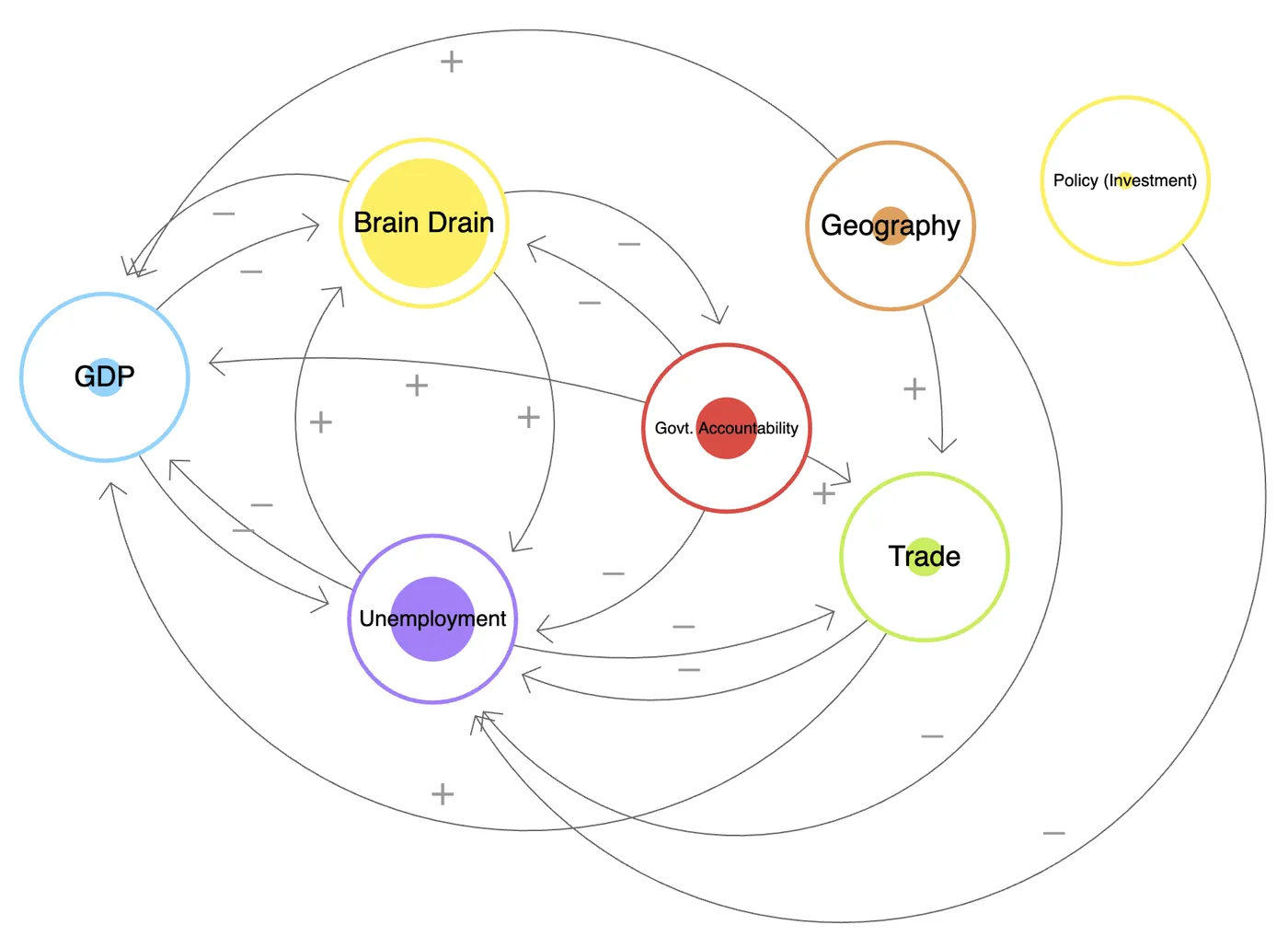
Figure 1. A deliberately simplified causal model of Nepal’s current economic state. The size of the coloured part of each node represents its current level. The trade node is sized by exports minus imports, and the geography node represents how easy infrastructure development and trade are. Interest rates and other factors matter but are left out for simplicity. Made with Loopy.
Nepal faces serious economic challenges. One is a high rate of brain drain: about 3.33% of the population emigrates each year for work or education (Jha, 2024).1 This exodus of “future leaders” worsens unemployment and reduces the pressure on government to be accountable (Figure 1). Landlockedness and mountainous terrain complicate trade and infrastructure development, contributing to a trade deficit, limited foreign currency reserves, and slower GDP growth (3.1%) than in neighbouring India (7%) and China (4.8%) (IMF, 2024).
Systemic corruption undermines the effectiveness of government spending across taxation, budget allocation, and project implementation, and further discourages foreign investment. Poor governance and cumbersome in-person formalities hold investment back. In the World Bank’s B-READY 2024 data, Nepal scores poorly on Regulatory Framework (59.34) and Public Services (49.29), which underlines its weak institutional foundations. Its Operational Efficiency score of 72.21, however, suggests that streamlined processes are within reach if implemented properly.
Existing government investment portals do not fill the gap. The Investment Board’s website, shown in Figure 2, failed a basic browser security check when I visited it. Portals in this state cannot replace in-person formalities or answer investors’ concerns. They act as barriers rather than facilitators. The digital inefficiency reflects deeper governance problems and further erodes investor confidence.

Figure 2. What a visitor saw on opening the website of the Investment Board Nepal, a high-level government body chaired by the Prime Minister, when this paper was written.
A behavioural economics perspective
Investor decisions are not driven only by objective cost-benefit analysis. Psychological factors strongly influence whether foreign capital enters a market. Perceptions of efficiency and readiness for the future, signalled through digitalisation and streamlined administration, can raise investor confidence. In Nepal’s context, digital portals are more than administrative tools. They are visible markers of governmental competence, transparency, and commitment to reducing corruption. Such signals can be as powerful as substantive regulatory reform, because investors often treat technological readiness as a proxy for the overall quality of governance.
Reducing the initial bureaucratic hurdles matters for related behavioural reasons. Status quo bias suggests that investors may avoid a new market altogether if the initial costs (time, complexity, uncertainty) look high, and stay in familiar territory such as India, China, or Vietnam. By simplifying entry, digitalisation makes the first step easier and breaks that inertia. Lower initial barriers also work with the sunk cost fallacy: once investors have started, they are more likely to continue in order to justify their initial effort.
This suggests that Nepal’s regulatory and service-delivery problems can be addressed through digital platforms and e-governance, which improve efficiency, transparency, and investor confidence by removing bureaucratic delay. Combined with Nepal’s relatively cheap labour (Jennings, 2017) and protectionist policies, such as an 80% import tax on luxury goods (Department of Customs, Nepal, 2024),2 these reforms create significant domestic cost advantages.
3. Economic growth
The empirical literature is mixed on the effect of FDI on growth in developing countries (Emako et al., 2022, p. 383). A common view, however, is that FDI leads to growth when the host country has the capacity to absorb it (human capital, institutional quality, and so on). FDI often brings technological spillovers. Nepalis who would otherwise leave the country can learn and use those technologies to drive growth.
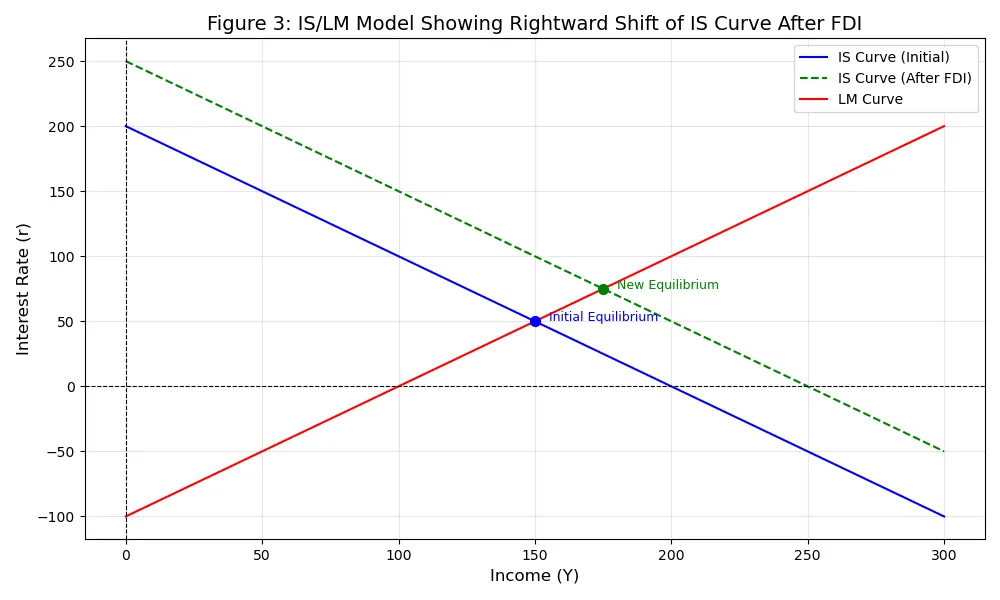
Figure 3. The IS/LM model. The initial IS curve (blue) represents equilibrium in the goods market. An increase in autonomous investment, partly from FDI, raises autonomous spending and shifts the IS curve to the right (green, dashed), so that equilibrium income is higher at any given interest rate. The LM curve (red) is unchanged, assuming an accommodating monetary policy. The economy moves from the initial equilibrium (blue dot) to one with higher income (green dot). The axes are illustrative, not calibrated to Nepal.
In the short run, higher FDI inflows act as a stimulus. They raise aggregate demand through higher autonomous investment and greater spending power among individuals and businesses. This shifts the IS curve to the right (Figure 3): equilibrium output and income rise while interest rates stay relatively stable, particularly if Nepal Rastra Bank, the central bank, takes an accommodative stance by buying bonds to increase the money supply, or at least by not reducing it.3 This is the mechanism by which lower bureaucratic barriers and higher investor confidence translate into growth.
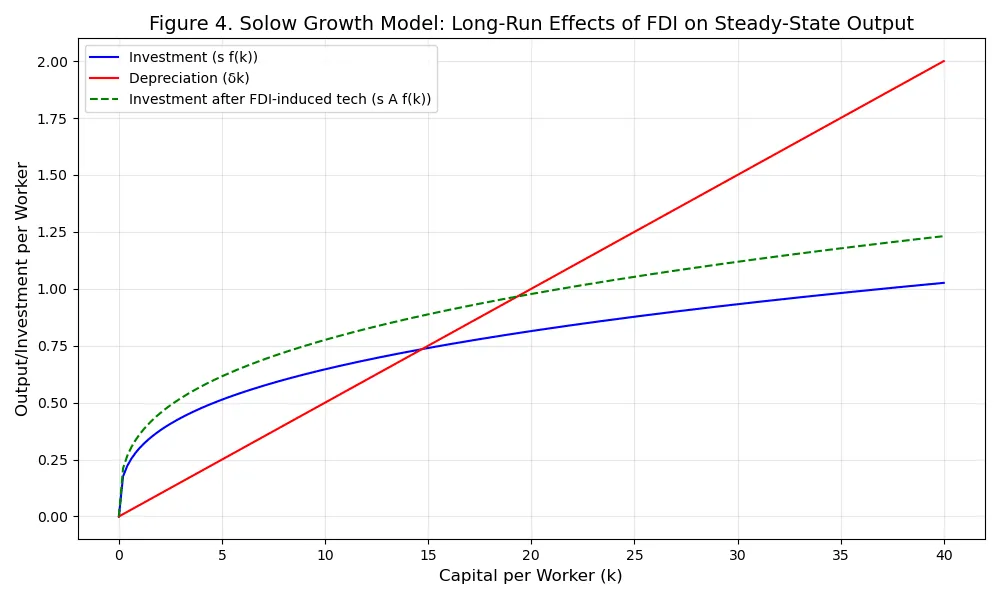
Figure 4. The Solow growth model. The steady state is where the investment curve, s·f(k), meets the depreciation line, δk. FDI inflows and the technological spillovers that come with them shift the production function up, from f(k) to A·f(k), which raises the investment curve and moves the steady state to a higher level of capital and output per worker.
For the long-run, second-order effects, I use the Solow growth model (Figure 4). In this framework, FDI is both a source of capital accumulation and a channel for technological spillovers, assuming the country has enough human capital to make use of the technology. (Figure 1 shows how GDP growth and employment opportunities work against brain drain.) Spillovers shift the production function up from f(k) to A·f(k), raising output per worker at any given level of capital per worker. The economy moves to a higher steady state with more capital per worker and higher output per worker. These changes are not immediate. They unfold over time, producing sustainable growth and higher living standards.
Nepal’s ability to benefit from FDI depends on complementary factors: human capital, governance, infrastructure, and a business environment that supports investment. Digitalising investment processes addresses systemic barriers such as corruption and inefficiency, which raises investor confidence and unlocks short-term gains in aggregate income. Over time, these reforms support productivity growth, technological advancement, and higher living standards.
4. Labour market outcomes
An influx of FDI driven by better digital governance has direct implications for Nepal’s labour market. As foreign firms set up operations, they create jobs in manufacturing, IT, and tourism, reducing unemployment and making use of underemployed labour.
Job creation and sector expansion. FDI increases demand for both skilled and unskilled domestic labour in factories, service centres, and technology hubs. That demand pushes wages up and improves living standards, while expanding industries stimulate supply chains and support local businesses.
Skill development and higher wages. FDI brings advanced managerial practices, training programmes, and technology. These require higher skills and create incentives for education and workforce development. Over time this raises productivity, justifies higher wages, and strengthens Nepal’s comparative advantage.
Knowledge-intensive employment and less brain drain. As industries shift toward knowledge-intensive production, better wages, working conditions, and skill development make opportunities at home more attractive to professionals and students who might otherwise emigrate. Retaining them supports local innovation and productivity, which creates a positive feedback loop: a skilled workforce attracts more FDI.
Labour market models. From a neoclassical perspective, an increase in investment shifts the labour demand curve outward, raising both equilibrium wages and employment. As workers upgrade their skills they become more productive, which raises the marginal product of labour and reinforces the upward pressure on wages. Fewer bureaucratic hurdles also raise investor confidence and reduce uncertainty, which behavioural economics identifies as important for sustaining investment over time. A more transparent and predictable environment encourages steady inflows of foreign capital and, with them, sustained improvement in labour market outcomes.
5. Plausibility and limitations
Plausibility
Nepal’s growing internet penetration and existing digital initiatives, at least in the big cities, indicate that it is ready enough to implement e-governance reforms. Other countries, such as Rwanda and Estonia, have used digital platforms to streamline administrative processes and offer examples Nepal can learn from.
Limitations and risks
The main limitations of the policy are:
- the uncertain effect of FDI on growth;
- limits on the country’s capacity to absorb technological spillovers;
- institutional resistance and corruption; and
- the cost of buying technology and training employees.
Digitalising the platform would reduce corruption at the initial stage, but investors could still be exploited at many later points. This policy cannot change that on its own; it needs supplementary policies and oversight. Not all government employees are trained to work digitally, and the switch would carry a one-time cost.
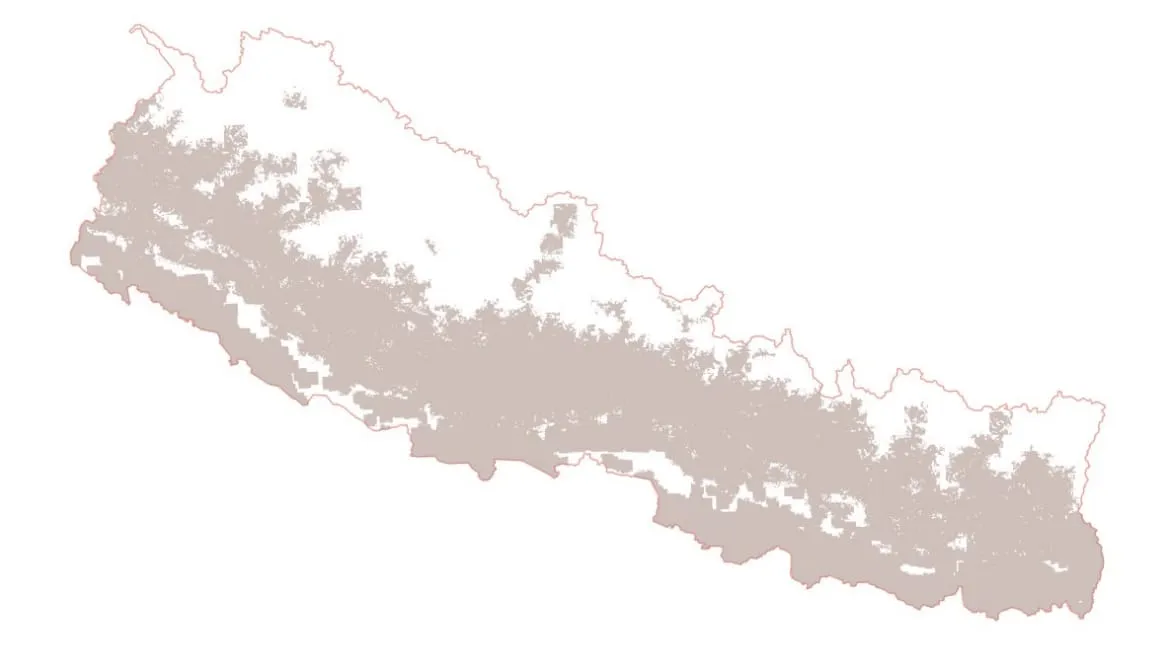
Figure 5. 4G coverage of Nepal Telecom (NTC), the largest and government-owned telecommunications provider, as of Asar 2080 BS (June–July 2023).4 Shaded areas have active 4G coverage, mostly in urban areas. Source: NTA (2023).
The digital transformation also carries risks. Unequal internet access (Figure 5) would widen the urban–rural divide and limit inclusive growth. Technical glitches and resistance from entrenched interests could slow implementation. Even digital systems can be captured by sophisticated actors, so robust oversight is required. Sudden large FDI inflows might cause the exchange rate to appreciate as demand for the Nepali rupee rises, assuming no change in demand for the Indian rupee,5 which would reduce the competitiveness of traditional export sectors. There is also the risk that foreign firms repatriate profits6 rather than reinvest locally, or come to dominate domestic markets and crowd out local businesses.
Mitigation
To address these problems, Nepal can invest in rural connectivity, or encourage investment in it, to make digital access inclusive. Legal frameworks must be strengthened to prevent regulatory capture, supported by transparent audits and whistle-blower protections. Macroeconomic policy should be watched closely: if currency inflows become excessive, the central bank can intervene to maintain stability, while prudent fiscal measures support balanced growth.
6. Conclusion
A centralised digital investment portal with legally binding decision timelines can make Nepal significantly more attractive to foreign investors by reducing bureaucratic inefficiency and corruption. The reform is expected to increase FDI, leading to immediate increases in aggregate demand and employment. In the long term it can drive productivity gains and growth. To realise these benefits, policymakers must deal with unequal internet access, limits on absorptive capacity, and the risk of exchange rate appreciation. Investment in infrastructure, inclusive digital access, and prudent macroeconomic management are essential if digitalisation is to translate into sustainable economic development for Nepal.
Notes
Use of AI. I used AI first to brainstorm ideas. Once I had settled on a topic, I used OpenAI’s GPT-4o to check that it suited the assignment. When my second draft ran over the word limit, I used GPT-4o to find where I was repeating information and to shorten some phrases.
References
Department of Customs, Nepal. (2024). Customs tariff 2080/81. Retrieved December 18, 2024, from https://customs.gov.np
Emako, E., Nuru, S., & Menza, M. (2022, December). The effect of foreign direct investment on economic growth in developing countries. Transnational Corporations Review, 14(4), 383. https://doi.org/10.1080/19186444.2022.2146967
IMF. (2024). Real GDP growth (World Economic Outlook DataMapper). Retrieved December 18, 2024, from https://www.imf.org/external/datamapper/NGDP_RPCH@WEO/OEMDC/ADVEC/WEOWORLD/BGD/BTN/IND/ALB/NPL
Jennings, R. (2017, April 12). From India To The Philippines, These Are the Cheapest Countries In Asia. Forbes. Retrieved December 18, 2024, from https://www.forbes.com/sites/ralphjennings/2017/04/12/these-are-the-5-cheapest-countries-in-asia/
Jha, H. B. (2024, March 15). Emptying Nepal. Observer Research Foundation. Retrieved December 18, 2024, from https://www.orfonline.org/expert-speak/emptying-nepal
NTA. (2023). Telecommunication Insight. Nepal Telecommunications Authority. Retrieved December 20, 2024, from https://nta.gov.np/uploads/contents/Telecommunication%20Insight%20Asar-2080.pdf
Transparency International. (2023). Nepal. Retrieved December 18, 2024, from https://www.transparency.org/en/countries/nepal
World Bank. (2024). Business Ready (B-READY) 2024. https://openknowledge.worldbank.org/server/api/core/bitstreams/08942fab-9080-4f37-b7be-ef61c9f9aed9/content
Footnotes
-
Roughly 1 million of Nepal’s 30 million people each year. ↩
-
The source is in Nepali. The 80% rate is taken from the customs tariff schedule, where it applies to most passenger vehicles (heading 8703). ↩
-
This is an assumption, and Nepal Rastra Bank’s decision would shape the outcome. I expect a coordinated effort between the bank, the legislature, and the executive. ↩
-
Nepal officially uses the Bikram Sambat (BS) calendar, which is approximately 56 years and 8 months ahead of the Gregorian calendar. Most formal publications use BS, hence the estimate of months here. ↩
-
The Nepali rupee is pegged to the Indian rupee, so an increase in demand for it might not raise its value linearly even when demand and supply of the Indian currency are constant. ↩
-
Repatriating: sending money back home. The Foreign Investment and Technology Transfer Act (FITTA) 2019 monitors foreign investments but does not require companies to reinvest profits. ↩