The Complexity of Discontent: Analyzing Nepal's Youth-Led Political Unrest
· 13 min read
Written for SS112: Political Science and Social Change, Minerva University, December 2025
Note: I wrote this paper in December 2025, three months after the protests it analyses. Events since then are not covered.
Introduction
Nepal, a federal democratic republic,1 has been politically volatile for two decades. From the abolition of the monarchy in 2008 to the promulgation of a new constitution in 2015, the country has been in near-permanent transition (PolSci Institute, 2024). The years 2022–2025, however, saw a different kind of unrest. Unlike the Maoist insurgency or the ethnic Madhes movements of the past, the recent wave of protest is decentralised and led by young people, and is often called the “Gen Z” movement. It is less about ideology than about governance: corruption, economic stagnation, and the hold of the “old guard”2 on political leadership.
This paper argues that the youth-led unrest is not merely a reaction to particular corruption scandals,3 but an emergent property of a complex system in which digital connectivity and economic frustration have lowered the cost of collective action and challenged the structural rigidity of the traditional political cartel. Gautam et al. (2025, p. 123) note that social media has become “critical infrastructure for political discourse” in Nepal, allowing young people to bypass party structures. I examine these dynamics through the lens of complexity science.
Data and visualisations
The 2025 Gen Z protests did not come from nowhere. Peaceful protests, and sometimes violent ones, are common in Nepal. Over the past six years the country has seen an average of roughly 200 protests a month (Figure 1).
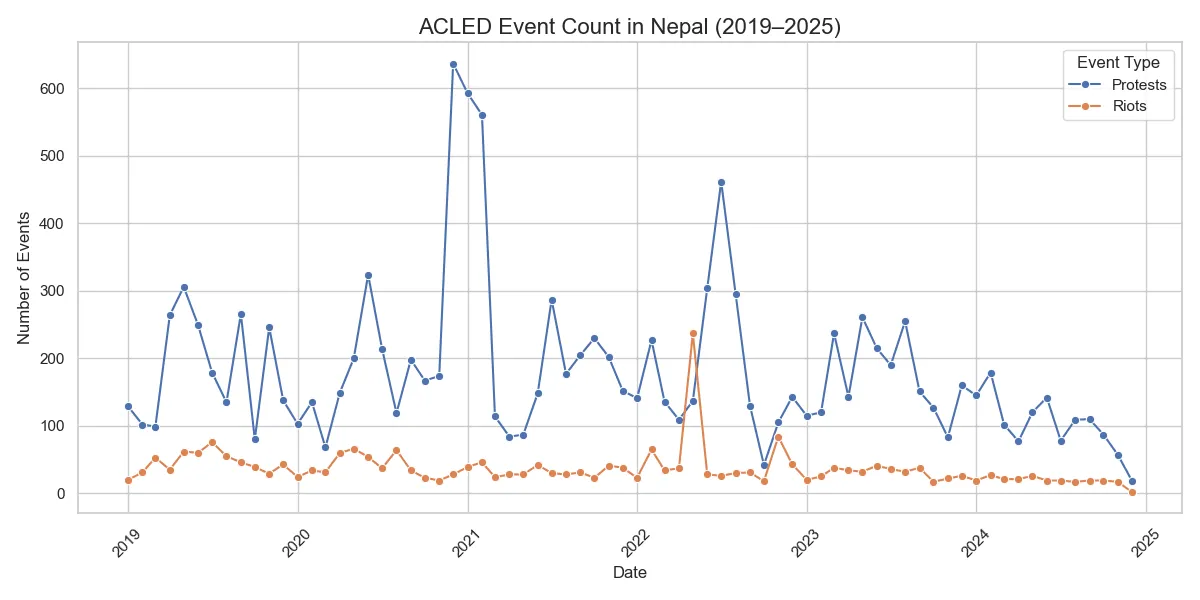
Figure 1. Monthly protest and riot events in Nepal recorded by ACLED, January 2019 to late 2024 (ACLED, 2024). Protest is routine, with spikes in late 2020 to early 2021 and again in mid-2022. The series ends before the September 2025 protests.
In the ACLED data, recent events are geographically dispersed, occurring not only in Kathmandu but in urban centres such as Pokhara, Chitwan, and Dharan, and the mix of events shifts away from organised political violence toward peaceful protest (ACLED, 2024).
Collective action theory holds that structural factors such as rising digital access reduce the cost of sharing information and create a “political opportunity window” for mobilisation (Gautam et al., 2025, p. 119). Figure 2 places the recent protests in the longer sequence of protest movements and regime changes in Nepal’s history.4
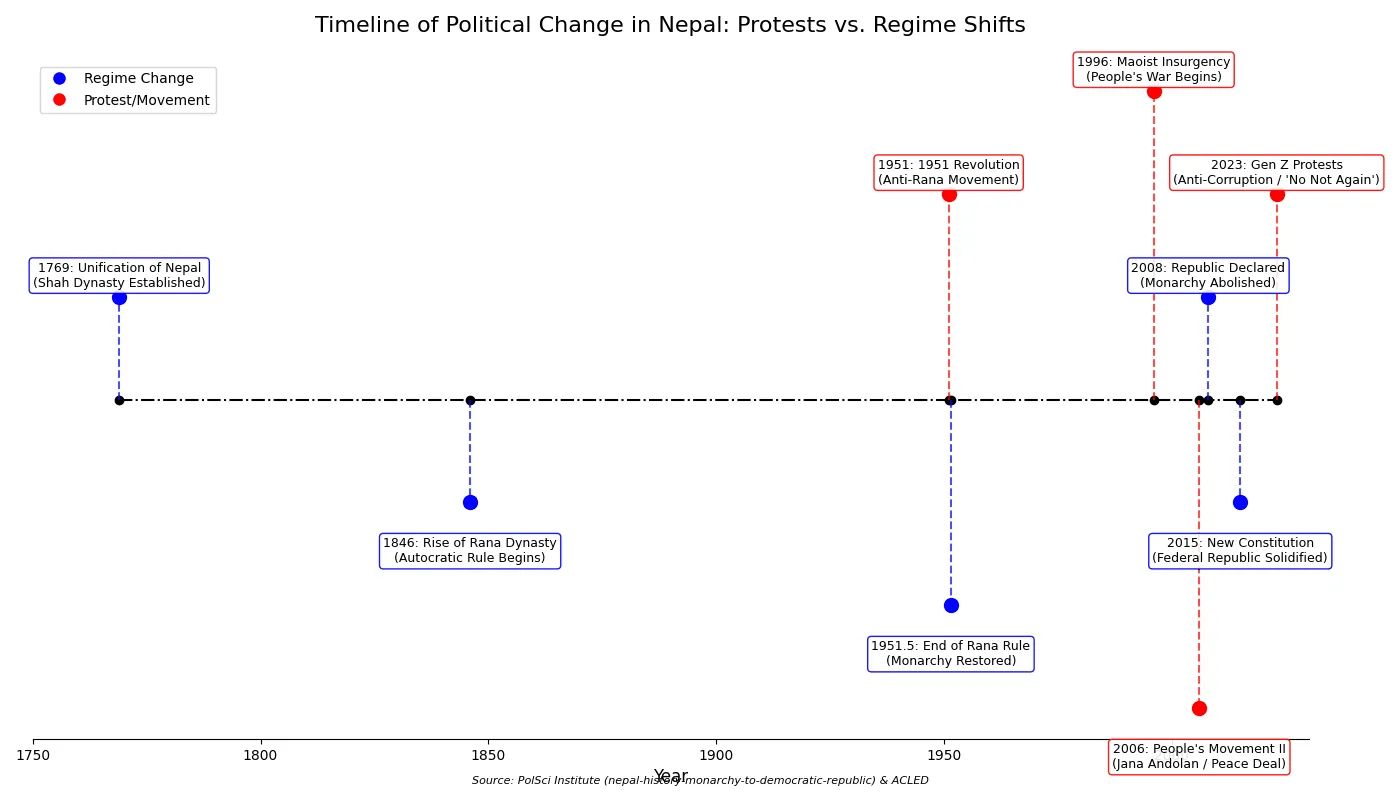
Figure 2. Major protest movements (red) and regime changes (blue) in Nepal’s history. The Gen Z protests of 2023–2025 are the latest wave of significant unrest.
Figure 3 shows that perceived corruption has stayed fairly constant across all regime types, with only a small, non-significant improvement since 2019.5
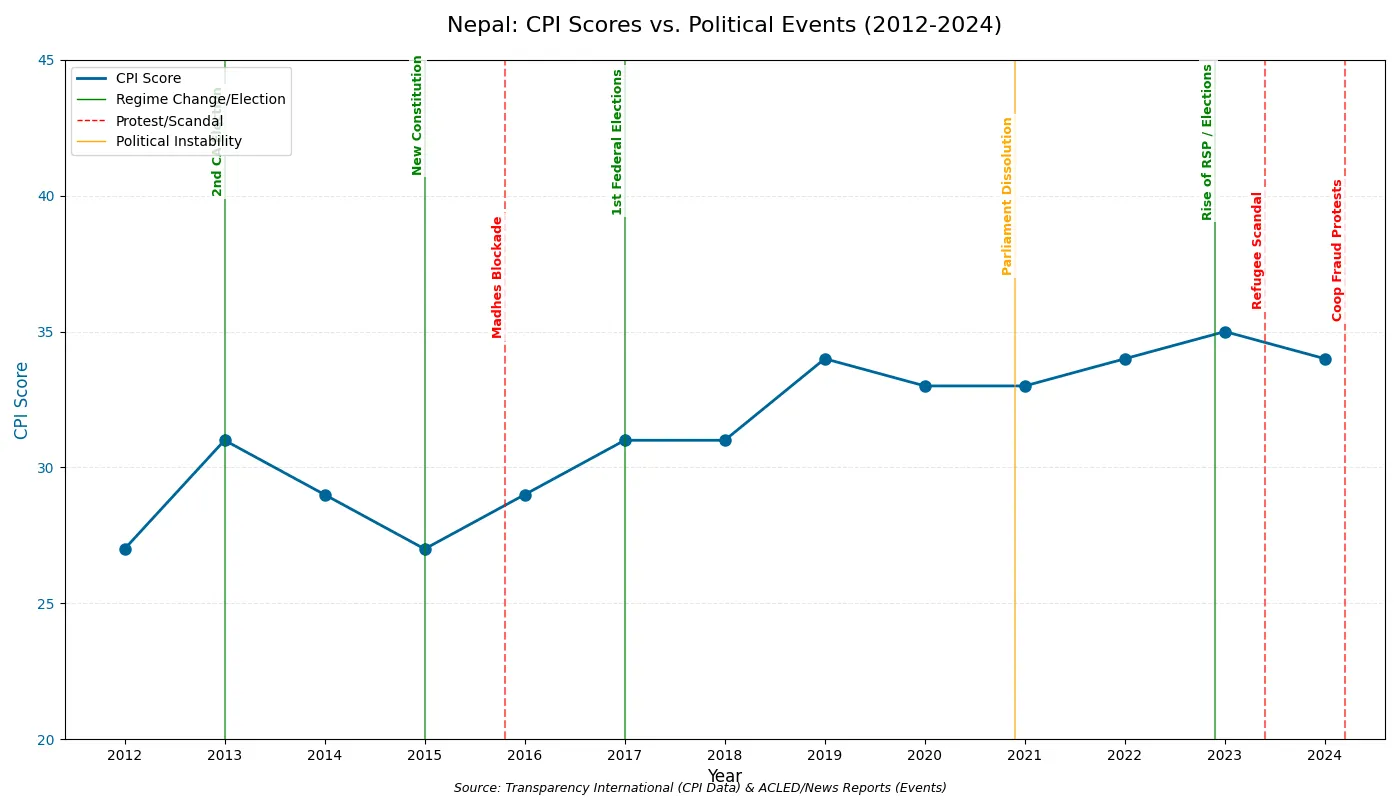
Figure 3. Nepal’s Corruption Perceptions Index score, 2012–2024, with key political events. Despite several changes of government and a new constitution, perceived corruption has remained high (scores at or below 35), feeding the cooperative-fraud and anti-corruption protests. CPI data: Transparency International.
In Nepal, interest in politics among respondents aged 18–29 remains high (over 60%), while confidence in political parties is at historic lows (below 15%) (Inglehart et al., 2022). The gap suggests that the unrest comes not from apathy but from frustrated engagement. The Carnegie Global Protest Tracker identifies corruption and economic justice as the main drivers of recent demonstrations (Carnegie Endowment, 2025). This fits recent structuralist analyses, which read the 2025 protests as a direct response to the marginalisation of young people and to governance failure (Barma & Thapa, 2025, p. 2).
Complexity analysis of the unrest
The unrest cannot be understood through a linear model of cause and effect. It is better seen as a complex system in which structural and social factors interact to produce emergent political behaviour.
Structuralism and the rigid political market
Through a structuralist lens, the unrest is a reaction to the rigid structure of Nepal’s political economy. For decades, politics has been dominated by a cartel of elderly leaders from the Nepali Congress, CPN-UML, and the Maoist Centre. This “syndicate system” creates high barriers to entry for new actors (Lawoti, 2010). The structure of the economy makes this worse: it relies heavily on remittances, which were worth about 26% of GDP in 2024 (World Bank, n.d.). The state has failed to generate domestic employment, and millions of young people have migrated. Those who stay face a structure in which access to opportunity depends on partisan patronage. The protests are therefore not only about particular policies. They are a structural critique of a system that makes migration a condition of survival.
Rational choice and the “No Not Again” phenomenon
From a rational choice perspective, the behaviour of young Nepalis can be analysed as a calculated decision between “Exit” and “Voice” (Hirschman, 1970). Historically the rational choice for the dissatisfied was Exit: migration to the Gulf, Malaysia, or the West. The recent protests, and the electoral rise of the Rastriya Swatantra Party (RSP)6 and of independent mayors such as Balen Shah in Kathmandu, represent a shift to Voice (Danuwar, 2025; Upadhyay, 2023; Giri, 2025).
The “No Not Again” campaign in the 2022 elections was a collective action problem solved through digital coordination (Rana, 2022).7 Individual voters understood that a solitary vote against the establishment was wasted unless it was coordinated. Social media supplied the cheap coordination mechanism that made Voice rational and viable. Young people calculated that the cost of continued old-guard rule (corruption, poor service delivery) now outweighed the cost of organising and protesting.
Complex causality and networks
The unrest was not triggered by a single event (the social media ban) but by the convergence of several feedback loops (Suwal, 2025).
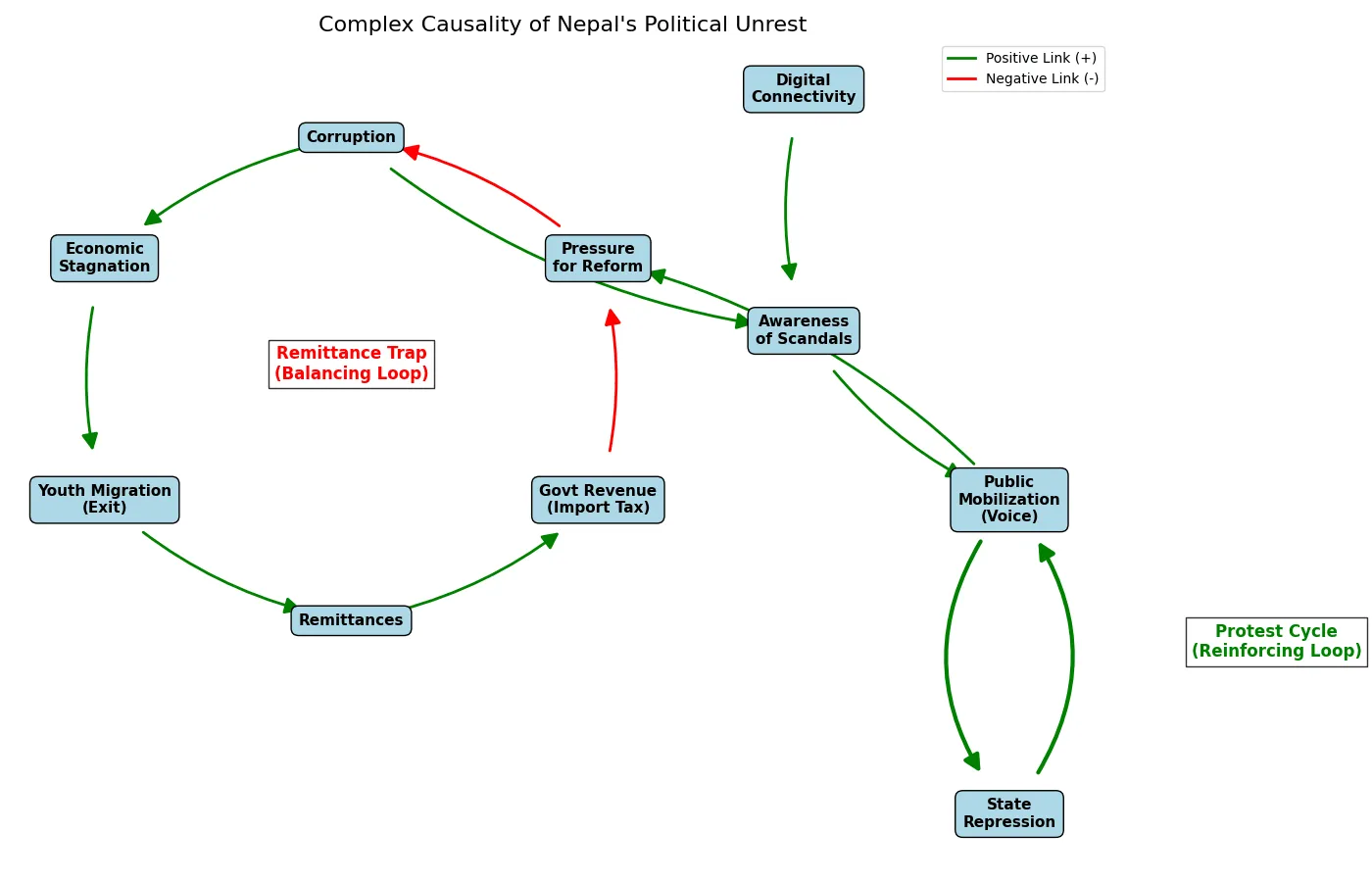
Figure 4. Causal loop diagram of the unrest. Green arrows are positive links, red arrows negative. The social media ban is treated as one tactic within “State Repression”. Generated in Python with NetworkX; the code is in the paper’s repository.
The main elements in Figure 4 are these.
The Remittance Trap (a balancing loop). This loop historically stabilised the system and created the structural rigidity described above. High corruption led to economic stagnation (a prolonged period of little or no growth, visible in unemployment and weak consumer spending), which pushed young people to migrate (Exit). Migrants sent back remittances, which funded government revenue through import taxes and reduced the immediate pressure for reform. The loop kept a corrupt system in equilibrium by exporting its dissatisfied population.
The Protest Cycle (a reinforcing loop). The recent unrest is a new reinforcing loop, an emergent property driven by digital connectivity. Corruption now leads to awareness of scandals, amplified by social media, which increases public mobilisation (Voice) and with it pressure for reform. Crucially, the Oli government’s attempt to suppress the movement by force backfired and fuelled mobilisation rather than dampening it (Sen & Tuladhar, 2025). At least 76 people were killed during the two days of protest (Human Rights Watch, 2026).
How the causes interact. Digital connectivity is a necessary condition for awareness of scandals to spread quickly, which lowers the cost of collective action. Economic stagnation is a standing cause that creates fertile ground for discontent. Specific scandals, such as the refugee scam, are triggering causes that activate the reinforcing loop.
System dynamics: the phase space of protest
To understand the trajectory of the unrest, the political system can be mapped onto a phase space with two dimensions: state repression on the horizontal axis and public mobilisation on the vertical axis.
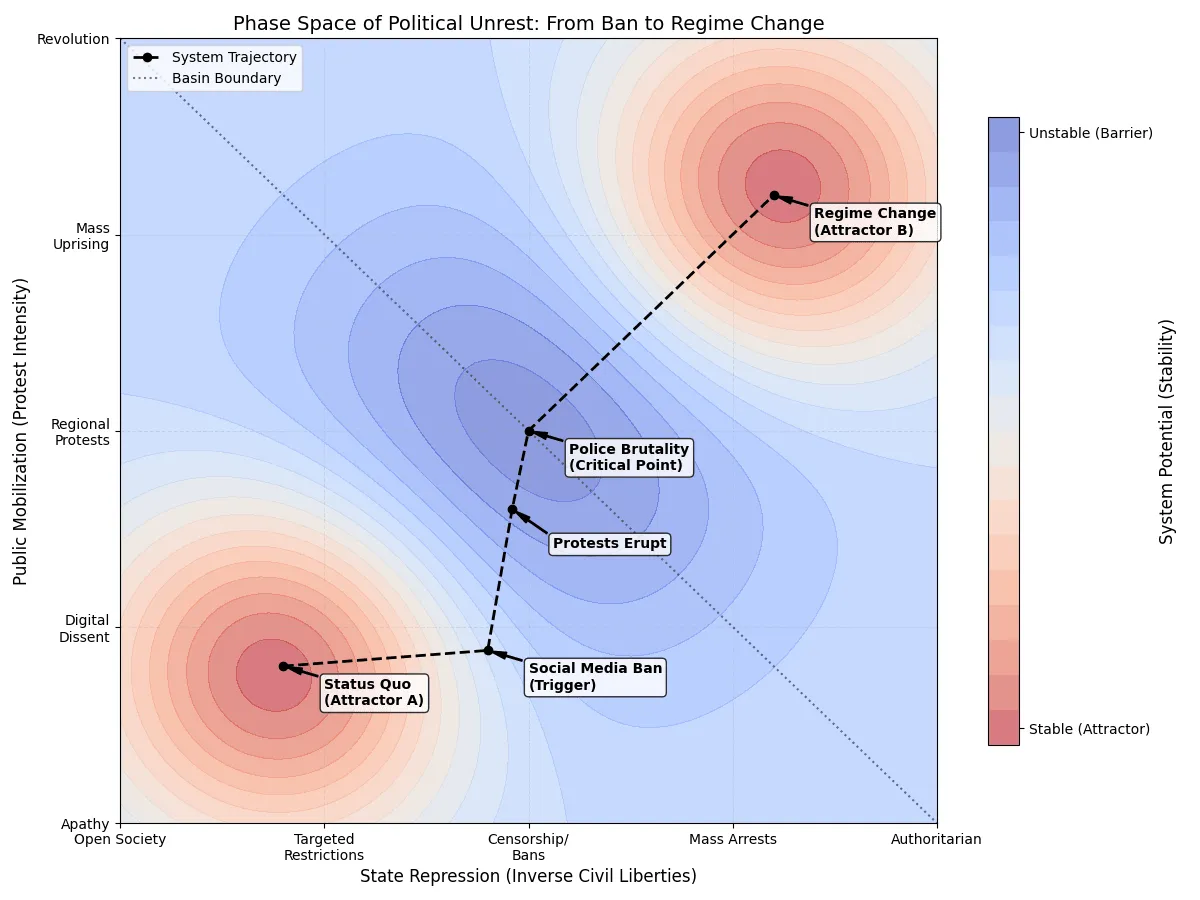
Figure 5. Phase space of the unrest. The horizontal axis, state repression, is grounded in V-Dem’s civil liberties index and runs from an open society to authoritarian control (for example, the TikTok ban and mass arrests). The vertical axis, public mobilisation, is grounded in ACLED protest data and runs from digital dissent (the “No Not Again” campaign) to mass uprising (the 2024–2025 protests). The system leaves the stable “Status Quo” attractor when the social media ban triggers it, climbs the potential barrier as protests erupt, crosses the critical point of police brutality, and falls into the “Regime Change” attractor.
The system has two main attractors:
- Attractor A (status quo). Moderate repression and low mobilisation. This is the stable equilibrium in which the syndicate system (the three-party rotation described earlier) operates comfortably.
- Attractor B (regime change or reform). A new stability, potentially with lower repression and institutionalised civic engagement.
Movement between the two basins follows specific dynamics. The social media ban pushed the system along the horizontal axis by increasing repression. Instead of suppressing dissent, it increased public mobilisation and pushed the system up the vertical axis. As protests intensified, the state responded with force. That police brutality was the critical point at the edge of the basin of attraction. Once the system crossed this threshold of violence, it could no longer return to the status quo. The energy of the system, public anger, was too high for the old equilibrium to contain, and the system moved toward a new attractor: either significant reform or a complete change of regime. In Nepal’s case the government resigned, and the House of Representatives was dissolved and an interim government formed by a route whose constitutionality is open to question (Beech & Loke, 2025).8
Conclusion
I read the Gen Z uprising not as a passing wave of anger but as a structural phase transition, driven by the collision of digital connectivity and economic stagnation. Seen through complexity science, the “No Not Again” campaign and the street protests that followed are emergent properties of a system in which the cost of collective action has fallen sharply, putting the old syndicate system under a strain it could not absorb. The analysis suggests that while the state tried to hold the equilibrium through repression, the reinforcing loops of digital mobilisation pushed the political system toward a new attractor. Future stability depends not on silencing this voice but on integrating a new generation into the structure of government: moving from a closed cartel to an open, responsive democracy.
Notes
Data and code. The data and Python code used for the figures are in github.com/jeevanbhatta/SS112.
Calendar. Several cited sources use the Bikram Sambat (Vikram Samvat) calendar, Nepal’s official calendar, for publication dates and for data used in the graphs. It runs approximately 57 years ahead of the Gregorian calendar.
Use of AI. I used Google’s Gemini to write some of the Python code for the visualisations, and Perplexity to search a few topics of interest before settling on the Gen Z protests.
References
Armed Conflict Location & Event Data Project (ACLED). (2024). Dashboard: South Asia. https://acleddata.com
Barma, P., & Thapa, S. (2025). The 2025 Nepalese Gen-Z Protests: A Structuralist Analysis of Youth Mobilization, Political Transformation, and Governance Reform. SUPRA: Global Journal of Humanities and Social Sciences Innovations. https://doi.org/10.71183/supra.2025020301
Beech, H., & Loke, A. (2025, October 8). How a Gen Z Revolution Spiraled Out of Control. The New York Times. Retrieved December 11, 2025, from https://www.nytimes.com/2025/10/08/world/asia/nepal-gen-z-revolution.html
Carnegie Endowment. (2025). Global Protest Tracker. Carnegie Endowment for International Peace. Retrieved December 11, 2025, from https://carnegieendowment.org/features/global-protest-tracker?lang=en
Danuwar, J. K. R. (2025). Political Shake-Up: Can Nepal’s Traditional Leaders Keep Up? Parewa News. https://www.parewanews.com/2025/07/05/29309
Gautam, D., Sapkota, S., & Baral, K. (2025). Digital Activism and Crisis in Nepal: Examining Gen-Z Movements and the Decline of Tourism. Kalika Journal of Multidisciplinary Studies, 7(1), 117–129. https://doi.org/10.3126/kjms.v7i1.86444
Giri, D. (2025). Breaking the Political Chain: A Quiet Revolution Among Young Nepalese. Medium. https://medium.com/@dibyesh_28636/breaking-the-political-chain-a-quiet-revolution-among-young-nepalese-8748d1853a0a
Hirschman, A. O. (1970). Exit, Voice, and Loyalty: Responses to Decline in Firms, Organizations, and States. Harvard University Press. https://www.hup.harvard.edu/books/9780674276604
House of Representatives, Nepal. (2025). Parliamentary Parties. Retrieved December 11, 2025, from https://hr.parliament.gov.np/en/parliamentary-parties
Human Rights Watch. (2026, February 12). Nepal: Publish Reports on Violent Crackdowns on Protests. https://www.hrw.org/news/2026/02/12/nepal-publish-reports-on-violent-crackdowns-on-protests
Inglehart, R., Haerpfer, C., Moreno, A., Welzel, C., Kizilova, K., Diez-Medrano, J., Lagos, M., Norris, P., Ponarin, E., & Puranen, B. (Eds.). (2022). World Values Survey: Round Seven - Country-Pooled Datafile. JD Systems Institute & WVSA Secretariat. https://www.worldvaluessurvey.org/WVSDocumentationWV7.jsp
Lawoti, M. (2010). Federal State-Building: Challenges in Framing the Nepali Constitution. Bhrikuti Academic Publications.
PolSci Institute. (2024). Nepal’s Contemporary History: Democratic Struggles and Milestones. https://polsci.institute/south-asia/nepal-democratic-struggles-milestones/
Rana, S. (2022). No place for the angry young man in Nepal’s democracy. East Asia Forum. https://eastasiaforum.org/2022/11/19/no-place-for-the-angry-young-man-in-nepals-democracy/
Sen, R., & Tuladhar, N. (2025, October 22). Nepal’s Gen Z protests are a call for democratic renewal. East Asia Forum. Retrieved December 11, 2025, from https://eastasiaforum.org/2025/10/22/nepals-gen-z-protests-are-a-call-for-democratic-renewal/
Suwal, S. (2025). The 2025 Gen Z Uprising in Nepal: A Three-Part Analysis. Harvard T. H. Chan School of Public Health. https://hsph.harvard.edu/atrocity-prevention-lab/news/the-2025-gen-z-uprising-in-nepal-a-three-part-analysis/
Transparency International. (2025, February 11). The ABCs of the CPI: How the Corruption Perceptions Index is calculated. Retrieved December 11, 2025, from https://www.transparency.org/en/news/how-cpi-scores-are-calculated
Upadhyay, A. (2023, May 4). In Nepal politics, a push for the new. Hindustan Times. Retrieved December 11, 2025, from https://www.hindustantimes.com/world-news/in-nepal-politics-a-push-for-the-new-101683130749655.html
Varieties of Democracy (V-Dem). (2024). Democracy Report 2024: Democracy Winning and Losing at the Ballot. University of Gothenburg. https://www.v-dem.net/publications/democracy-reports/
World Bank. (n.d.). Personal remittances, received (% of GDP) - Nepal [Data]. Retrieved December 11, 2025, from https://data.worldbank.org/indicator/BX.TRF.PWKR.DT.GD.ZS?locations=NP
Footnotes
-
This is the official name. Nepal does have relatively free elections, although the major parties spend disproportionate amounts of money on them, and a formal separation of powers. In practice, three parties trading places in government through shifting coalitions gives them control of the institutions and weakens the accountability of the branches to one another. Nepal has moved back and forth on the democracy–autocracy spectrum throughout its history, though the overall direction has been toward democracy. ↩
-
The long-standing leaders: K.P. Sharma Oli (CPN-UML), Sher Bahadur Deuba (Nepali Congress), and Pushpa Kamal Dahal (CPN Maoist Centre). They have served as prime minister three, five, and three times respectively. Oli was Prime Minister during the 2025 protests. ↩
-
Much international coverage presented the social media ban as the cause of the protests. The protesters themselves were clear that it was only the trigger. See the system-dynamics section below. ↩
-
This is not a causal argument. Other factors are in play, such as changes of regime and rising literacy. There is correlation and possibly causation, but establishing causation is outside the scope of this paper. ↩
-
A CPI score of 0 means extremely corrupt and 100 means entirely clean. The index measures perceptions of corruption, not corruption itself. It draws on at least three sources per country, including the World Bank and the World Economic Forum, and there is still room for bias and fear in the reported data (Transparency International, 2025). ↩
-
The party was founded by Rabi Lamichhane, a journalist who hosted the television show Sidha Kura Janata Sanga (loosely, “Straight Talk with the People”). Think of Volodymyr Zelenskyy’s career in entertainment before he became president. There was a great deal of hope in the party. As of December 2025 it was the fourth-largest party, with about 8% of seats in parliament, just behind the three old-guard parties (House of Representatives, Nepal, 2025). ↩
-
Nepal’s Election Commission asked for the campaign to be shut down. The young people behind it doubled down instead. ↩
-
As I read Articles 76 and 77 of Nepal’s constitution, the outgoing Prime Minister has to request the dissolution of the House, and only members of the House can become Prime Minister. Neither condition was met here. See The Kathmandu Post’s analysis. ↩